Emil Jönsson, Sweden, took his first win in the Royal Palace Sprint Race, here ahead of Jesper Nodin from Sweden, Petter Northug (Norge), Andrew Newell (USA), Ola Vigen Hattestad (Norway) and Fulvio Scola (Italy).
Today the FIS World Cup sprint competition took place around the Royal Palace in Stockholm. A great event with new snow in the streets and beautiful sunshine. The two days ended with a Swede, Emil Jönsson winning the Men’s final. The crowd went crazy!
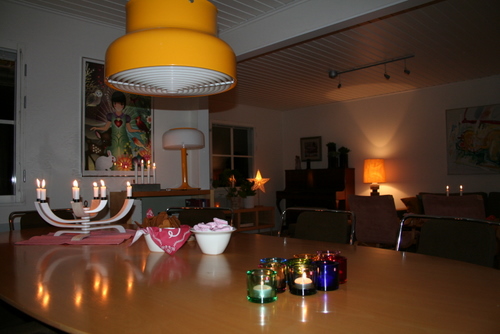
Today I visited the Retromässan in the Münchenbryggeriet on Södermalm, Stockholm. The Bumling lamp from ateljé Lyktan seems to become a real design classic. Designer in 1968 was Anders Pehrson. It was on display in many colors and sizes.
Our large one is quite unique. Two years ago we bought ours at Folk & Form, today they had great other 60’s and 70’s items on this Retromässan, but for good prices, you need to be on Blocket or be lucky on garage sales…..
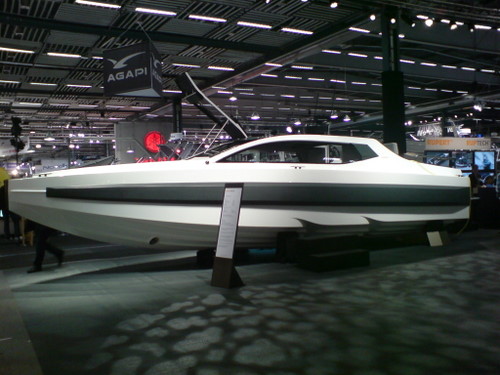
Yesterday evening we went to the Stockholm International Boatshow (Allt för sjön) and had a wonderful time watching the beautiful boat on display. Conventional boat like Targa, Bella, Flipper, Ryds, Aquador and AMT. But the modern designed boats were amazing, think about the new Delta 40 Sidewalk. But the most extreme boat on show was the boat pictured above: Ruptech 32. Have a look at the pictures!
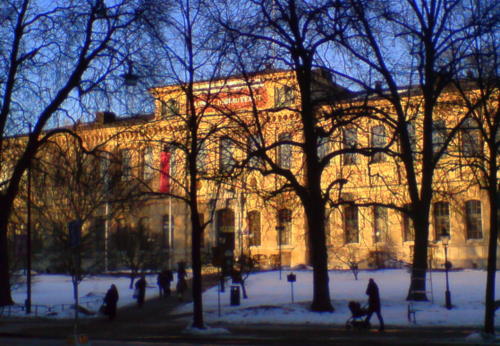
The Kungliga biblioteket (Royal library) in Stockholm this afternoon.
A beautiful spring day, temperature slightly above 4 degrees, but with the sun quite warm.
Today is the Vasaloppet, an annual long distance (90 km) cross-country ski race (ski marathon) held on the first Sunday of March in Dalarna, between Sälen and Mora. It is the oldest, one of the longest, and in popular consideration the biggest cross-country ski race in the world. The race was first run in 1922, inspired by a run by King Gustav Vasa in 1520.
Today, 14.730 skiers started.
In the year 46 B.C a calendar was accepted with a true year that was 365¼ days long. A year became 365 days and every 4th year was a laep year. However, a deficiency was discovered in the calculation of time in that was then called Julian timekeeping (i.e., the Julian calendar). A tropical year was shorter by a difference of 0.9987 of a day. This doesn´t amount to much, but 128 years it becomes one day ( 128×0.0078=0.9984 days)
By the 1500s the difference had become 10 days, which affected Easter such that it came later in the year. An adjustment to the calendar took place at the iniative of Pope Gregoruis and with a papl Bull in 1582 a 10 days corretion was applied so that October 5th, 1582 became October 15th.
The rule for leap years was changed. A year is a leap year if eighter it is divisible bt 4 but not by 100, or it is divisible by 400. In other words, a year that is divisible by 4 is a leap year unless it is divisible by 100 not by 400, in which case it is not a leap year. Thus 1600 (as well as 2000) are leap years, but not 1700, 1800, or 1900. This reduced the number of Leap years by 3 over a 400-year period. The deviation the became 0.0003 days a year or 26 seconds a year, and shifted the one-day difference to 3000 year.
Catholic countries switched to the new calendar in 1582, but out of prestige the Protestant countris didn´t accept the papal Bull until 1700, exept for Sweden ( and Finland). The 10-day correction didn´t occur in Sweden in 1700.
Due to a debate in 1699 for and against the change, Sweden (and Finland) sought to gradually implement the 10-day correction imposed by the new calendar starting with the first leap year after 1700. But the Nordic wars occurred in the meantime and the reform stopped.
Consequently Sweden (and Finland) stayed with their own calendar. Karl XII ordered a return to the original Julian calendar in 1712. The leap year for 1712 was re-instated and accounting for one prior leap year February 1712 became 28 days+1+1 or 30 days.
Sweden (and Finland) changed over to the Gregorian calendar in 1753. A 10-day correction was applied so that February 17th, 1753 became March 1th.








 Posts