home

[ Content | Sidebar ]

Låtefossen waterfalls in Odda – N 🇳🇴

September 23rd, 2018

International Volvo Photo Locations Part 317
HOME - Volvo Photo Locations
HOME www.volvophotolocations.com

2017 – Volvo V60 Cross Country at Låtefossen waterfalls on RV 13 in Odda, Norway 🇳🇴

2017 – Volvo V60 Cross Country at Låtefossen waterfalls on RV 13 in Odda, Norway 🇳🇴

2018 – Låtefossen waterfalls on RV13 in Odda, Norway (Google Streetview)

2018 – Låtefossen waterfalls on RV13 in Odda, Norway (Google Streetview)

Låtefossen or Låtefoss is a waterfall located in the municipality of Odda in Hordaland County, Norway. The 165-metre tall waterfall is unique and thus it is a well-known tourist attraction in the area. It is special in that it consists of two separate streams flowing down from the lake Lotevatnet, and as they fall, the join together in the middle of the waterfall, just before going under the Norwegian National Road 13, making for a spectacular (and wet) view as one drives over the old, stone, six-arched bridge.

Famous twin-waterfall close to route 13. Låtefoss is the king among our waterfalls and an internationally famous attraction.

At the southern end of the waterfall, you might follow the path leading to where the hotel was previously lying. Today you only observe the ruins of the hotel estate.

More information at en.wikipedia.org and visitnorway.com.

Volvo Photography Locations

Lot #29 on Gothersgade in Copenhagen – DK 🇩🇰

September 23rd, 2018

International Volvo Photo Locations Part 316
HOME - Volvo Photo Locations
HOME www.volvophotolocations.com

2019 – Volvo XC40 at Lot #29 on Gothersgade 29 in Copenhagen Danmark 🇩🇰.

2017 – Volvo V40 at Lot #29 on Gothersgade 29 in Copenhagen Danmark 🇩🇰.

2017 – Volvo V40 at Lot #29 on Gothersgade 29 in København Danmark 🇩🇰.

2017 – Volvo V40 at Lot #29 on Gothersgade 29 in Copenhagen, Denmark 🇩🇰.

2018 – Lot #29 on Gothersgade in Copenhagen 🇩🇰.

2018 – Lot #29 on Gothersgade in Copenhagen, Denmark (Google Streetview)

Lot #29 is Copenhagen’s most New York-ish clothing store and is located in Gothersgade. The two Danish women Cecilie Kølpin and Line Hallberg combine their own clothing and jewelry designs with other labels from around the world, but primarily New York and Italy.

Gothersgade is a major street in the City Centre of Copenhagen, Denmark. It extends from Kongens Nytorv to Sortedam Lake, passing Rosenborg Castle and Gardens, Nørreport Station and Copenhagen Botanic Gardens on the way.

Every day at 11:30 am, the Royal Life Guards, who are based at Rosenborg Barracks, depart from Rosenborg Eksercerplads and march down Gothersgade and up Bredgade for the ceremonial changing of the guard at 12 noon at Amalienborg Palace Square.

Gothersgade runs along the original course of the Eastern Rampart of Copenhagen’s former Fortification Ring. Originally called Ny Kongensgade, it was established in about 1647 after the Eastern Rampart had been taken in a more northerly direction to expand the fortified city with a large new area known as New Copenhagen. At his point the street only ran to the site of today’s Nørreport Station where it met the fortifications just north-east of the North City Gate.

In 1870, after the fortifications had been decommissioned and their grounds leveled out, the street was extended to its current length.

In 1892, Copenhagen’s first public electricity plant, Gothersgade elektriske Centralstation, opened at the corner of Gothergade and Adelsgade. It was installed behind the existing house fronts towards Gothergade and was unusual for its central location.[2] It was later expanded and modernized several times. Since 1994, it had only served as a substation for distribution of electricity and central heating.

In 1920–30 the section of Gothersgade from Rosenborg Castle Gardens to Sortedam Lake was widened. In the process, Rosenborg Barracks was shortened with two bays and the drill house from 1787 and Brøndkuranstalten in front of Rosenborg Castle were demolished. A planned widening of the section of the street closest to Kongens Nytorv was later abandoned.

The prefix Gothers- in the street name refers to the Goths of the title King of the Goths and the Wends which was used by Danish kings from the 14th century until 1972. Vendersgade, which is Gothersgade’s mirror image on the other side of Frederiksborggade, refers to the Wends of the same title.

More information at en.wikipedia.org and lot29.dk.

Volvo Photography Locations

Nylandsveien near Barcode in Oslo – N 🇳🇴

September 23rd, 2018

International Volvo Photo Locations Part 315
HOME - Volvo Photo Locations
HOME www.volvophotolocations.com

2017 – Volvo V40 on Nylandsveien near Barcode in Oslo, Norway 🇳🇴

2018 – Nylandsveien near Barcode in Oslo (Google Streetview)

The Barcode Project is a section of the Bjørvika portion of the Fjord City redevelopment on former dock and industrial land in central Oslo. It consists of a row of new multi-purpose high-rise buildings, that was completed in 2016. The developer is marketing the project as “The Opera Quarter.” There has been intense public debate about the height and shape of the buildings.

Barcode seen from The new Opera house

The Barcode buildings are between Dronning Eufemias gate (Queen Eufemia’s Street), which will be the main east–west thoroughfare in the Bjørvika neighborhood and is a stretch of what is currently Bispegata, and Trelastgata (Timber Street, a new street that during planning was also called Sporgata, Track Street), which will run alongside the rail lines to Oslo Central Station on the northern edge of the development. A line of apartment buildings will be between Dronning Eufemias gate and the Oslofjord, where the new Oslo Opera House has already been built.

Some are enthusiastic about the fresh architecture, the “champagne apartments,” and the unmatched opportunity to reshape the urban landscape and relieve pressure on a rapidly growing city without diminishing existing green space.
However, there has been widespread criticism of the heights and designs of the Barcode buildings, both from architects and from citizens of Oslo. The Barcode has been described as a barrier between the fjord and the rest of the city that will destroy Oslo’s character as an open, low-rise city with a lot of green space and cast a permanent shadow on adjacent neighborhoods for the benefit of a rich few.
The architecture has been described as chaotic, as part of a trend of spectacular buildings, which within a few years will be seen as having disfigured the city. In addition to the disruption of the very large building site, the project has been described as hostile to the urban life of the city: unbalanced in favor of private business space and with too few shopping and eating opportunities for the public, and narrow, corridor-like passages between the buildings.

The project “is among the most protested . . . ever in Oslo.” A petition campaign in opposition to the building of the high-rises received over 30,000 signatures in 2007, and according to a survey by Aftenposten in December of the same year, 71% of the population of Oslo opposed the project. In 2008 a charrette was organized to find alternatives.

More information at en.wikipedia.org and www.dezeen.com.

Volvo Photography Locations

Rostockgata at Barcode in Oslo – N 🇳🇴

September 23rd, 2018

International Volvo Photo Locations Part 314
HOME - Volvo Photo Locations
HOME www.volvophotolocations.com

2018 – Volvo XC40 R-Design at Rostockgata in Oslo 🇳🇴

2018 – Volvo XC40 at Rostockgata in Oslo 🇳🇴

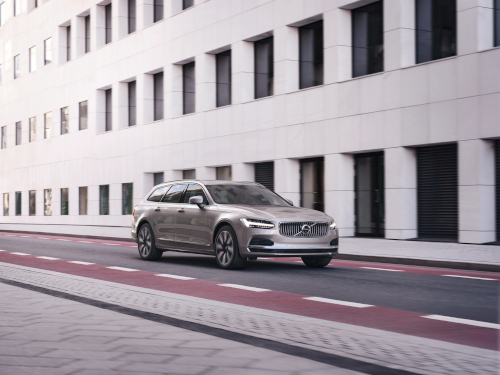
2025 – Volvo V90 Plus Nordic Edition on Rostockgata at Barcode in Oslo, Norway 🇳🇴.

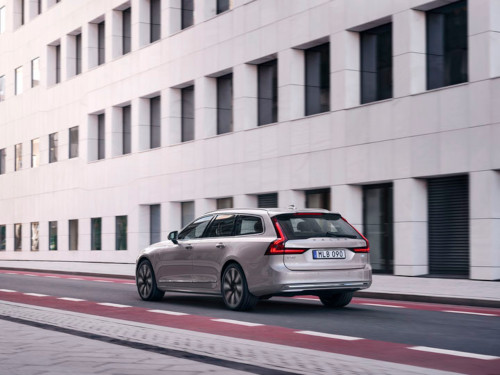
2025 – Volvo V90 Plus Nordic Edition on Rostockgata at Barcode in Oslo, Norway 🇳🇴.

2017 – Volvo V40 on Rostockgata at Barcode in Oslo, Norway 🇳🇴 (photography by Marcel Pabst)

2017 – Volvo V40 at Rostockgata in Oslo 🇳🇴

2017 – Volvo V40 at Rostockgata in Oslo 🇳🇴

2018 – Rostockgata at Barcode in Oslo, Norway (Google Streetview)

2018 – Rostockgata at Barcode in Oslo, Norway (Google Streetview)

2018 – Rostockgata at Barcode in Oslo, Norway (Google Streetview)

Rostockgata is a street in the Barcode area in Bjørvika, Oslo in Norway. The street runs between Trelastgata and Dronning Eufemias gate.

The white building shown in the photos houses DNB NOR and is called DNB öst-bygget (east building).

DnB NOR Building. Architects: MVRDV, Dark Arkitekter and a-lab. Three buildings linked by a below-ground “street” area, with restaurants and other shared areas on the first and second floors.

Building A (east): 37,000 sq. m., architect: MVRDV and co-architects Dark Arkitekter. The center building and the new headquarters of the financial company. Offices will be grouped around voids and the exterior cladding will be 6-meter square “pixels.”

Building B (central): 22,500 sq. m. Architect: a-lab. The eastern building, on the longest site, will be set back behind a plaza on Dronning Eufemias gate and have offices on the lower floors, apartments with terraces on the upper floors.

Building C (west): 14 floors, 13,000 sq. m. Architect: Dark Arkitekter. The western DnB NOR tower will be stepped, with a restaurant, bar, and terrace on the top floor accessible from Dronning Eufemias gate. The building will be clad in glass reflective panels tilted at slightly differing angles to reflect different fractions of the surrounding scenery.[22][23] To open 2012.

The Barcode Project is a section of the Bjørvika portion of the Fjord City redevelopment on former dock and industrial land in central Oslo. It consists of a row of new multi-purpose high-rise buildings, that was completed in 2016. The developer is marketing the project as “The Opera Quarter.” There has been intense public debate about the height and shape of the buildings.

Barcode seen from The new Opera house

More information at en.wikipedia.org and kunsthalloslo.no.

Volvo Photography Locations

DNB West-Building on Wismargata at Barcode in Oslo – N 🇳🇴

September 22nd, 2018

International Volvo Photo Locations Part 313
HOME - Volvo Photo Locations
HOME www.volvophotolocations.com

2019 – Volvo XC90 Inscription at DNB West-Building on Wismargata in Barcode in Oslo Norway 🇳🇴

2019 – Volvo XC90 Inscription at DNB West-Building on Wismargata in Barcode in Oslo Norway 🇳🇴

2018 – Volvo XC40 at DNB House West-Building on Wismargata in Barcode in Oslo Norway 🇳🇴

2018 – Volvo XC40 at WDNB House West-Building on ismargata in Barcode in Oslo Norway 🇳🇴

2018 – Volvo XC40 near DNB House West-Building at Wismargata in Barcode in Oslo Norway 🇳🇴

2018 – Volvo XC40 near DNB House West-Building on Wismargata in Barcode in Oslo Norway 🇳🇴

2018 – Volvo XC40 near DNB House West-Building at Wismargata in Barcode in Oslo Norway 🇳🇴

2018 – Volvo XC40 near DNB House West-Building on Wismargata in Barcode in Oslo Norway 🇳🇴

2018 – Volvo XC90 near DNB House West-Building on Wismargata at Barcode in Oslo, Norway 🇳🇴

2018 – Volvo XC90 at DNB House West-Building on Wismargata at Barcode in Oslo Norway 🇳🇴

2018 – Volvo V40 Cross Country near DNB House West-Building on Wismargata in Barcode in Oslo Norway 🇳🇴

2017 – Volvo V40 near DNB House West-Building on Wismargata at Barcode in Oslo, Norway 🇳🇴 (photography by Marcel Pabst)

2017 – Volvo V40 near DNB House West-Building on Wismargata at Barcode in Oslo, Norway 🇳🇴 (photography by Marcel Pabst)

2018 – Wismargata at Barcode in Oslo (Google Streetview)

2018 – Wismargata at Barcode in Oslo (Google Streetview)

2018 – Wismargata

Making of… by This Is Made at DNB House West-Building on Wismargata in Barcode in Oslo Norway

2018 – Volvo XC40 near DNB House West-Building at Wismargata in Barcode in Oslo Norway (Making of… with Sam Christmas)

2018 – Volvo XC40 near DNB House West-Building at Wismargata in Barcode in Oslo Norway (Making of… with Sam Christmas)

Wismargata is a street in the Barcode area in Bjørvika, Oslo in Norway. The street runs between Trelastgata and Dronning Eufemias gate.

The black building shown in the photos houses DNB and is called DNB vest-bygget (west building).

2018 – DnB West Building by Dark Architects

The DNB west building has a powerful expression, with spectacular angles and a very special facade.
The façade is characterized by large, thick, square stones in matt, black granite, which can look like pixels at a distance. The building is built as a huge staircase, with several terrace plateaus.

Barcode seen from The new Opera house

The Barcode Project is a section of the Bjørvika portion of the Fjord City redevelopment on former dock and industrial land in central Oslo. It consists of a row of new multi-purpose high-rise buildings, that was completed in 2016. The developer is marketing the project as “The Opera Quarter.” There has been intense public debate about the height and shape of the buildings.

More information at no.wikipedia.org, archdaily.com and darkarkitekter.no.

Volvo Photography Locations

Den Gamle Færgehavn near Storebæltsbroen in Korsør – DK 🇩🇰

September 22nd, 2018

International Volvo Photo Locations Part 312
HOME - Volvo Photo Locations
HOME www.volvophotolocations.com

2017 – Volvo XC60 at Den Gamle Færgehavn near Storebæltsbroen in Korsør Danmark

2017 – Volvo XC60 at Den Gamle Færgehavn near Storebæltsbroen in Korsør Danmark

2017 – Volvo XC60 at Den Gamle Færgehavn near Storebæltsbroen in 4220 Korsør Danmark

Photos of the new Volvo XC60 were created by Stendahls together with Patrik Johäll /Superstudio, MFX and Cabbe /Adamsky Division

Den Gamle Færgehavn near Storebæltsbroen in Korsør in Denmark

Den Gamle Færgehavn near Storebæltsbroen in Korsør in Denmark

Den Gamle Færgehavn near Storebæltsbroen in Korsør is a former harbor of the ferry over the Great Belt in Denmark.

Korsør is a Danish town and port. It is out on the Great Belt, on the Zealand side, just south of where the Great Belt Bridge lands. It was the site of the municipal council of Korsør municipality – today it is part of Slagelse municipality.
Formerly the main ferry port from Zealand to Funen, the town of Korsør is divided into two halves by the Korsør Nor inlet, with the northern part named Halskov. Most of the historical southern part of Korsør is low-lying and prone to flooding.

The Storebæltsforbindelsen or Great Belt Fixed link is a multi-element fixed link crossing the Great Belt strait between the Danish islands of Zealand and Funen. It consists of five structures: a road suspension bridge and a railway tunnel between Zealand and the small island Sprogø located in the middle of the Great Belt, and a box girder bridge for both road and rail traffic between Sprogø and Funen. The “Great Belt Bridge” (Danish: Storebæltsbroen) commonly refers to the suspension bridge, although it may also be used to mean the box-girder bridge or the link in its entirety. The suspension bridge, officially known as the East Bridge, has the world’s third longest main span (1.6 km), and the longest outside of Asia. It was designed by the Danish engineering firms COWI and Ramboll.

The link replaced the ferry service that had been the primary means of crossing the Great Belt. After more than five decades of speculation and debate, the decision to construct the link was made in 1986;[2] the original intent was to complete the railway link three years before opening the road connection, but the link opened to rail traffic in 1997 and road traffic in 1998.

The Great Belt ferries (Danish: Storebæltsfærgerne) were the train and car ferries operating across the Danish strait of Great Belt, between the islands of Zealand and Funen. up to the late 1990s The railway ferry link was established in 1883, while automobile-only ferries started operating in 1930.

The ferry services ceased operating with the opening of the Great Belt Fixed Link, which occurred in 1997 for rail and 1998 for car traffic. Despite the popularity of the fixed link, some ferries still connect eastern and western Denmark. The company Mols-Linien continues to operate ferries between northwest Zealand and East Jutland, while the Spodsbjerg–Tårs route some 45 kilometres to the south also remains serviced by ferries.

More information at en.wikipedia.org and www.storebaelt.dk.

Volvo Photography Locations

Quiraing in Portee on Skye in Scotland – UK 🇬🇧

September 22nd, 2018

International Volvo Photo Locations Part 311
HOME - Volvo Photo Locations
HOME www.volvophotolocations.com

2017 – Volvo V90 Cross Country at Quiraing on Skye in Scotland, UK

2017 – Volvo V90 Cross Country at Quiraing on Skye in Scotland, UK

2017 – Volvo V90 Cross Country at Quiraing on Skye in Scotland, UK

2017 – Volvo V90 Cross Country at Quiraing on Skye in Scotland, UK

2017 – Volvo V90 Cross Country at Quiraing on Skye in Scotland, UK

2017 – Volvo V90 Cross Country at Quiraing on Skye in Scotland, UK

2018 – Quiraing in Portee on Skye in Scotland – UK (Google Streetview)

2018 – Quiraing in Portee on Skye in Scotland – UK (Google Streetview)

2018 – Quiraing in Portee on Skye in Scotland – UK (Google Streetview)

The Quiraing is a landslip on the eastern face of Meall na Suiramach, the northernmost summit of the Trotternish on the Isle of Skye, Scotland. The whole of the Trotternish Ridge escarpment was formed by a great series of landslips; the Quiraing is the only part of the slip still moving—the road at its base, near Flodigarry, requires repairs each year.

2018 – View from Quirang (Wikipedia)

Parts of the distinctive landscape have earned particular names. The Needle is a jagged 37 m high landmark pinnacle, a remnant of land slipping. Northwest of it is The Table, a flat grassy area slipped down from the summit plateau, with vistas of the Torridon Hills and the mountains of Wester Ross. Southwest is the Prison, a pyramidal rocky peak which can look like a medieval keep when viewed from the right angle – the ascent of this is an airy scramble.

The name Quiraing comes from Old Norse ‘Kví Rand’, which means “Round Fold”. Within the fold is The Table, an elevated plateau hidden amongst the pillars. It is said that the fold was used to conceal cattle from Viking raiders.

More information at en.wikipedia.org and www.theskyeguide.com.

Volvo Photography Locations

Just found Volvo Photo Locations from Sweden 🇸🇪 (1927-1999)

September 1st, 2018

Volvo Photo Atlas - Volvo Photo Locations Overview
bookmark www.volvophotolocations.com today!

The search for Volvo Photo Locations continues all the time. At this page we list the newly found photos locations from Sweden with Volvo photos between 1927 and 1999. Have a look at the other pages for more newly found Volvo photo locations or help us the find new unkown Volvo photo locations!

Have a look at our 2 pages where we show the photos with Volvo Cars on locations that we just have not yet found: 1927-1999 and 2000-2026. Maybe you know any place in your city or country that was once used as a Volvo Photo Location! Your help and any tips are highly appreciated, use my contact form or through Instagram.

With your help, I managed to identify the following photos:

1976 – Volvo 264 TE at Villa Berghem on Stallbacken in Särö, Kungsbacka in Sweden 🇸🇪.

1976 – Volvo 264 TE at Villa Berghem on Stallbacken in Särö, Kungsbacka in Sweden 🇸🇪.

1973 – Volvo 144 Taxi at Villa Berghem on Stallbacken in Särö, Kungsbacka in Sweden 🇸🇪.

1969 – Volvo 164 at Mellby Gård in Sösdala, Sweden 🇸🇪.

1969 – Volvo 164 at Mellby Gård in Sösdala, Sweden 🇸🇪.

1969 – Volvo 164 at Mellby Gård in Sösdala, Sweden 🇸🇪.

1996 – Volvo 940 Polar Estate at Kolboryds Gård on Kolborydsvägen in Lerum, Sweden 🇸🇪. (Scanned photo from the 1996 Japanese brochure, page fold and text cleaned with AI.)

1976 – Volvo 265 at Kolboryds Gård on Kolborydsvägen in Lerum, Sweden 🇸🇪.

1996 – Volvo 940 GLE on Norrmalmstorg at Smålandsgatan and Biblioteksgatan in Stockholm, Sweden 🇸🇪. (Scanned photo from the 1996 Japanese brochure, page fold and text cleaned with AI.)

1996 – Volvo 940 GLE on Norrmalmstorg at Smålandsgatan and Biblioteksgatan in Stockholm, Sweden 🇸🇪.

1997 – Volvo C70 near Uddestenbrottet in Myren on Bohus-Malmön, Sweden 🇸🇪.
Great photography for Volvo Cars by Claes Axstål!

1997 – Volvo C70 near Uddestenbrottet in Myren on Bohus-Malmön, Sweden 🇸🇪.
Great photography for Volvo Cars by Claes Axstål!

1997 – Volvo C70 near Uddestenbrottet in Myren on Bohus-Malmön, Sweden 🇸🇪.
Great photography for Volvo Cars by Claes Axstål!

1998 – Volvo S80 near Uddestenbrottet in Myren on Bohus-Malmön, Sweden 🇸🇪.
Great photography for Volvo Cars by Claes Axstål!

1998 – Volvo S80 near Uddestenbrottet in Myren on Bohus-Malmön, Sweden 🇸🇪.
Great photography for Volvo Cars by Claes Axstål!

1961 – Volvo P1800 on John Ericssons väg with view on Lorensborgsgatan in Malmö, Sweden 🇸🇪.
Great photography for Volvo Cars by Georg Oddner! #georgoddner

1961 – Volvo P1800 on John Ericssons väg with view on Lorensborgsgatan in Malmö, Sweden 🇸🇪.
Great photography for Volvo Cars by Georg Oddner! #georgoddner

1973 – Volvo 1800 ES at Eckrans Hus on Käringbergsgatan in Långedrag, Göteborg, Sweden 🇸🇪.

1973 – Volvo 1800 ES at Eckrans Hus on Käringbergsgatan in Långedrag, Göteborg, Sweden 🇸🇪.

Eckrans Hus – also known as Stora Eckran, or Nya Eckran as it was called when it was built in 1906 – was designed by architect Sigfrid Ericson. He also created one of Gothenburg’s most distinctive landmarks, Masthuggskyrkan, and served as the chief architect of the 1923 Jubilee Exhibition, during which attractions such as Liseberg and Götaplatsen, including the Konstmuseet, were established.

At the time, Sigfrid Ericson was principal of what is now the Högskolan för Design och Konsthandverk and had a strong interest in arts and crafts. This is reflected in the house’s rich decorative details. His architecture is characterized by meticulous craftsmanship, steep roofs, and creative compositions that merge different building volumes into a harmonious whole.

The building was constructed in the National Romantic style, featuring distinct Viking-inspired decorations and Old Norse design elements, ornamental woodcarvings, and pagan motifs. In addition, two small dogs wearing amusing hats are carved into separate pillars. This may be a trace of the fish merchant Justus Hansson, who is said to have commissioned the construction of Eckrans Hus.

The house was designed as a place for celebrations and social gatherings. Its architectural forms seem to embrace visitors from the moment they step onto the gravel courtyard. The unusually tall chimneys further enhance the impression by drawing the eye upward and giving the house a sense of reaching toward the sky. Inside, there are spacious assembly halls and an elevated stage intended for performances and soirées.

The property originally occupied a large portion of the block along Eckragatan, Patrullgatan, and Kuttergatan. It included, among other things, residences for a chauffeur and a gardener, as well as orchards and ponds. In 1966, the grounds were subdivided to make room for eight brick villas.

Throughout its 120-year history, Eckrans Hus has provided a welcoming setting for countless gatherings, celebrations, musical events, art exhibitions, and many weddings. Here, the stories live on in a house dedicated to community, joy, and moments to remember.

1961 – Volvo P1800 on John Ericssons väg with view on Lorensborgsgatan in Malmö, Sweden 🇸🇪.
Great photography for Volvo Cars by Georg Oddner! @georgoddner @georgoddnerphotography #georgoddner

1965 – Volvo Amazon in the freight harbor on Bunkerkajen of Helsingborg, Sweden 🇸🇪.
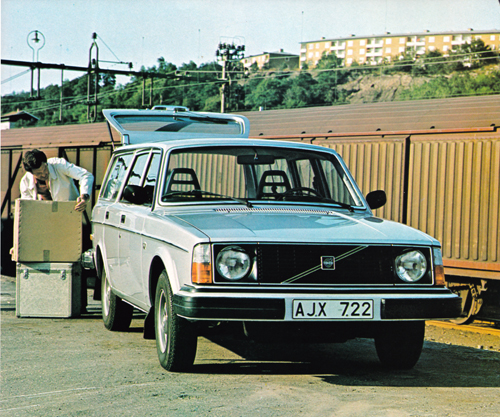
1978 – Volvo 245 DL at SJs Godsmagasin (freight depot) near the (former) Mölndals Nedre railway station in Mölndal, south of Göteborg, Sweden 🇸🇪. Note: the E6 motorway was here opened in 1980.

1992 – Volvo 940 Business Edition at Lindholmspiren with view on Delawaremonumentet, Sjöbefälsskolan and Läppstiftet in Göteborg, Sweden 🇸🇪.

1985 – Volvo 740 GL at Palmhuset in Trädgårdsföreningen in Göteborg, Sweden 🇸🇪.
Great photography for Volvo Cars by Thomas Dirk Heere!

1985 – Volvo 740 GL at Palmhuset in Trädgårdsföreningen in Göteborg, Sweden 🇸🇪. Great photography for Volvo Cars by Thomas Dirk Heere!

1986 – Volvo 240 GL Sedan on Bergdalavägen in Kivik, Sweden 🇸🇪. Photography by Thomas Dirk Heere.

1986 – Volvo 740 Turbo Estate at Skånes Fallskärmsklubb on Fallskärmsvägen in Gärds Köpinge near Kristianstad Österlen Airport, Sweden 🇸🇪.
Great photography for Volvo Cars by Thomas Dirk Heere!

1985 – Volvo 760 GLE at Flyinge Kungsgård Chefsbostaden in Flyinge in Skåne, Sweden 🇸🇪.
Great photography for Volvo Cars by Thomas Dirk Heere!

1985 – Volvo 760 GLE at Flyinge Kungsgård Stora ridhuset in Flyinge in Skåne, Sweden 🇸🇪.
Great photography for Volvo Cars by Thomas Dirk Heere!

1986 – Volvo 740 GL Estate at Flyinge Kungsgård in Flyinge in Skåne, Sweden 🇸🇪.

1988 – Volvo 360 GLE on Strandvägen in Djursholm, Danderyd in Sweden 🇸🇪. Photography by Thomas Dirk Heere.

1988 – Volvo 360 GLE on Strandvägen in Djursholm, Danderyd in Sweden 🇸🇪. Photography by Thomas Dirk Heere.

1988 – Volvo 360 GLE on Strandvägen in Djursholm, Danderyd in Sweden 🇸🇪. Photography by Thomas Dirk Heere.

1988 – Volvo 360 GLE on Strandvägen in Djursholm, Danderyd in Sweden 🇸🇪. Photography by Thomas Dirk Heere.
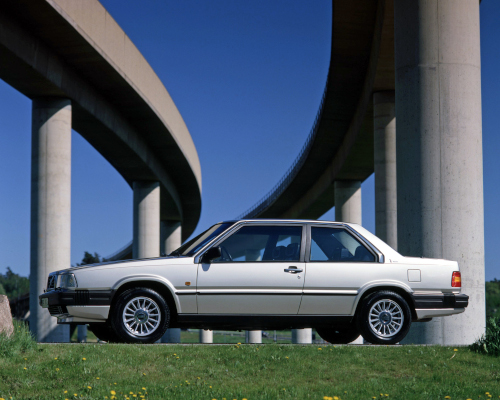
1988 – Volvo 780 on Danmarksgatan near Kista Galerian in Kista, Sweden 🇸🇪. Photography by Thomas Dirk Heere.

1988 – Volvo 780 at Lida Herrgård in Åkers Styckebruk, Sweden 🇸🇪. Photography by Thomas Dirk Heere.

1988 – Volvo 780 at Lida Herrgård in Åkers Styckebruk near Strängnäs in Södermanland, Sweden 🇸🇪. Photography by Thomas Dirk Heere.

1986 – Volvo 240 GL Estate at Kiviks Marknad on Kiviks Stations Väg in Kivik, Sweden 🇸🇪. Photography by Thomas Dirk Heere.

1986 – Volvo 240 GL Estate at Kiviks Marknad on Kiviks Stations Väg in Kivik, Sweden 🇸🇪. Photography by Thomas Dirk Heere.

1986 – Volvo 240 GL Sedan at Vitemölla Källebacken on Kiviks Stations Väg in Kivik, Sweden 🇸🇪. Photography by Thomas Dirk Heere.

1986 – Volvo 240 GL Sedan at Vitemölla Källebacken on Kiviks Stations Väg in Kivik, Sweden 🇸🇪. Photography by Thomas Dirk Heere.

1988 – Volvo 740 GL at Såstaholms Herrgård in Såsta in Täby, Sweden 🇸🇪. Photography by Thomas Dirk Heere.

1988 – Volvo 360 GLT Injection at Käppala Båtsällskap on Södra Kungsvägen in Käppala on Lindingö, Sweden 🇸🇪. Photography by Thomas Dirk Heere.

The ship in this press photo is named Birka Princess, a well-known cruise ship operated by Birka Cruises, sailing between Stockholm and Mariehamn from 1986 to 2006. It became especially popular for its entertainment cruises and for appearing in the Swedish TV series Rederiet under the name M/S Freja. After being sold in 2006, the ship was renamed M/S Sea Diamond and tragically sank near Santorini in 2007.

1988 – Volvo 360 GLE at Friibergh Herrgård in Örsundsbro, Sweden 🇸🇪. Photography by Thomas Dirk Heere.

1997 – Volvo C70 on Almungevägen in Rosersberg, Upplands Väsby, Sweden 🇸🇪. (Photography by Lennart Ström and rig by Lasse Jonasson!)

1997 – Volvo C70 on Almungevägen in Rosersberg, Upplands Väsby, Sweden 🇸🇪. (Photography by Lennart Ström and rig by Lasse Jonasson!)

1999 – Volvo S40 at Vindarnas Tempel on Sörhallskajen in Göteborg, Sweden 🇸🇪.

1997 – Volvo 960 at Rollin Bistro Backyard at Gamlestadens Fabriker on Väverigatan in Göteborg, Sweden 🇸🇪.

1988 – Volvo 360 GLT at Stockholms Segelflygklubb SSFK @segelflyg on Långtora Flygfält near Örsundsbro in Enköping, Sweden 🇸🇪. Photography by Thomas Dirk Heere.

1988 – Volvo 360 GLT at Stockholms Segelflygklubb SSFK @segelflyg on Långtora Flygfält near Örsundsbro in Enköping, Sweden 🇸🇪. Photography by Thomas Dirk Heere.

1988 – Volvo 360 GLT at Stockholms Segelflygklubb SSFK @segelflyg on Långtora Flygfält near Örsundsbro in Enköping, Sweden 🇸🇪. Photography by Thomas Dirk Heere.

1988 – Volvo 360 GLT at Stockholms Segelflygklubb SSFK @segelflyg on Långtora Flygfält near Örsundsbro in Enköping, Sweden 🇸🇪. Photography by Thomas Dirk Heere.

Note: The pictured glider (segelflygplan in Swedish) with ID SE-TVH is a Schleicher ASK 21, produced in 1980 in Germany. It was owned by the Stockholms Segelflygklubb in Stockholm. On the 21 of July 1982, it was involved in a plane crash at the Långtorna segelflygplats, where it was damaged, but the pilot and the passenger were not hurt. Since it appears on the Volvo Press photos from 1988, it was repaired. The Stockholm Segelflygklubb bought the glider plane in 1980 and sold it in 2004.

1991 – Volvo 240 Polar Estate at Gamla Vattentornet on Skolgatan in Lysekil, Sweden 🇸🇪.

1970 - Volvo 164 at IBM Huset or Montessori Mondial Lidingö School on Vesslevägen in Lidingö, Stockholm, Sweden.

1970 – Volvo 164 at IBM Huset or Montessori Mondial Lidingö School on Vesslevägen in Lidingö, Stockholm, Sweden 🇸🇪. This building (Kv Fjällräven 1) used to be house the nordic research department of IBM. IBM sold the property in 1997 and in the high building new student apartment were realized (1999), the lower buildings houses today a school.

1926 – Volvo ÖV4 Prototype on Östra Hamnvägen in Varberg, Sweden 🇸🇪.

1996 – Volvo S70 at Casa Linné on Kungstorget 5 in Göteborg, Sweden 🇸🇪.

1956 – Volvo Sport P1900 on Kungstorget in Uddevalla, Sweden 🇸🇪.

1956 – Volvo Sport P1900 on Kungstorget in Uddevalla, Sweden 🇸🇪.

1945 – Volvo PV444 at Naturhistoriska riksmuseet on Roslagsvägen in Stockholm, Sweden 🇸🇪.

1968 – Volvo 1800 S at Brodda Stuteri on Brodda in Skurup, Skåne, Sweden 🇸🇪.

1968 – Volvo 1800 S at Brodda Stuteri on Brodda in Skurup, Skåne, Sweden 🇸🇪.

1971 – Volvo 144 Polis at Polishuset Göteborg on Ernst Fontells Plats in Göteborg, Sweden 🇸🇪.

1956 – Volvo Sport P1900 Prototype at Säve gård on Kongahällevägen near Bärbyvägen in Göteborg, Sweden 🇸🇪.

1956 – Volvo Sport P1900 Prototype at Säve gård on Kongahällevägen near Bärbyvägen in Göteborg, Sweden 🇸🇪.

1974 – Volvo 144 de Luxe at Villa Ekebacken on Aspenvägen in Lerum, Sweden 🇸🇪.

1974 – Volvo 144 de Luxe at Villa Ekebacken on Aspenvägen in Lerum, Sweden 🇸🇪.

1974 – Volvo 144 Grand Luxe at Villa Ekebacken on Aspenvägen in Lerum, Sweden 🇸🇪.

1974 – Volvo 144 Grand Luxe at Villa Ekebacken on Aspenvägen in Lerum, Sweden 🇸🇪.

1974 – Volvo 144 Grand Luxe at Villa Ekebacken on Aspenvägen in Lerum, Sweden 🇸🇪.

1994 – Volvo 850 Sedan at Villa Pauli in Djursholm, Stockholm, Sweden 🇸🇪. (Photography by Thomas Dirk Heere)

1994 – Volvo 850 Sedan on Globentorget in Johanneshov, Stockholm, Sweden 🇸🇪. (Photography by Thomas Dirk Heere)

1994 – Volvo 850 Sedan on Globentorget in Johanneshov, Stockholm, Sweden 🇸🇪. (Photography by Thomas Dirk Heere)

1994 – Volvo 850 Sedan at Gustav Adolfstorg in Stockholm, Sweden 🇸🇪. (Photography by Thomas Dirk Heere)

1994 – Volvo 850 Sedan on Stadsgårdshamnen in Stockholm, Sweden 🇸🇪. (Photography by Thomas Dirk Heere)

1994 – Volvo 850 Sedan on Stadsgårdshamnen in Stockholm, Sweden 🇸🇪. (Photography by Thomas Dirk Heere)

1994 – Volvo 850 T-5 Turbo Estate on Strandvägen in Djursholm, Stockholm, Sweden 🇸🇪. (Photography by Thomas Dirk Heere)

1994 – Volvo 850 T-5 Turbo Estate on Strandvägen in Djursholm, Stockholm, Sweden 🇸🇪. (Photography by Thomas Dirk Heere)

1994 – Volvo 850 T-5 Turbo Estate on Sjövikskajen at Årstaviken in Stockholm, Sweden 🇸🇪. (Photography by Thomas Dirk Heere)

1994 – Volvo 850 T-5 Turbo Estate on Nybrokajen in Stockholm, Sweden 🇸🇪. (Photography by Thomas Dirk Heere)

1994 – Volvo 850 T-5 Turbo Estate at Årsta Säteri in Österhaninge, Stockholm, Sweden 🇸🇪. (Photography by Thomas Dirk Heere)

1994 – Volvo 850 T-5 Turbo Estate at Evert Taubes Terrass on Riddarholmen in Stockholm, Sweden 🇸🇪. (Photography by Thomas Dirk Heere)

1994 – Volvo 940 Sedan on Vasabron in Stockholm, Sweden 🇸🇪. (Photography by Thomas Dirk Heere)

1994 – Volvo 940 Sedan on Stadsgårdshamnen in Stockholm, Sweden 🇸🇪. (Photography by Thomas Dirk Heere)

1994 – Volvo 940 Sedan on Norra Riddarholmshamnen on Riddarholmen in Stockholm, Sweden 🇸🇪. (Photography by Thomas Dirk Heere)

1994 – Volvo 940 Sedan at Täby Sjöflygklubb on Pontongrän in Täby, north of Stockholm, Sweden 🇸🇪. (Photography by Thomas Dirk Heere)

1994 – Volvo 940 Sedan at Klara Mälarstrand in Stockholm, Sweden 🇸🇪. (Photography by Thomas Dirk Heere)

1995 – Volvo 940 S 2.3 Estate on Sjövikskajen at Årstaviken in Stockholm, Sweden 🇸🇪. (Photography by Thomas Dirk Heere)

1995 – Volvo 940 S 2.3 Estate on Olof Palmes gata and Drottninggatan in Stockholm, Sweden 🇸🇪. (Photography by Thomas Dirk Heere)

1995 – Volvo 940 S 2.3 Estate on Norrlandsgatan and Mäster Samuelsgatan in
Stockholm, Sweden 🇸🇪. (Photography by Thomas Dirk Heere)

1995 – Volvo 940 S 2.3 Estate on Norr Mälarstrand in Stockholm, Sweden 🇸🇪. (Photography by Thomas Dirk Heere)

1945 – Volvo PV444 A prototype/pre-production on Panoramavägen in Keillers Park in Göteborg, Sweden 🇸🇪. (Photography by Karl Werner Gullers / KW Gullers)

1945 – Volvo PV444 A prototype/pre-production on Panoramavägen in Keillers Park in Göteborg, Sweden 🇸🇪. (Photography by Karl Werner Gullers / KW Gullers)

1945 – Volvo PV444 A prototype/pre-production on Panoramavägen in Keillers Park in Göteborg, Sweden 🇸🇪. (Photography by Karl Werner Gullers / KW Gullers)

1945 – Volvo PV444 A prototype/pre-production on Panoramavägen in Keillers Park in Göteborg, Sweden 🇸🇪. (Photography by Karl Werner Gullers / KW Gullers)

1945 – Volvo PV444 A prototype/pre-production on Panoramavägen in Keillers Park in Göteborg, Sweden 🇸🇪. (Photography by Karl Werner Gullers / KW Gullers)

1945 – Volvo PV444 A prototype/pre-production on Panoramavägen in Keillers Park in Göteborg, Sweden 🇸🇪. (Photography by Karl Werner Gullers / KW Gullers)

1945 – Volvo PV444 A prototype/pre-production on Panoramavägen in Keillers Park in Göteborg, Sweden 🇸🇪. (Photography by Karl Werner Gullers / KW Gullers)

1945 – Volvo PV444 A prototype/pre-production on Panoramavägen in Keillers Park in Göteborg, Sweden 🇸🇪. (Photography by Karl Werner Gullers / KW Gullers)

1942 – Volvo PV56 as Polis Radiobil on Kungsportsavenyn between Stora teatern and Trädgårdsföreningen in Göteborg, Sweden 🇸🇪. (Photography by KW Gullers)

1942 – Volvo PV56 as Polis Radiobil on Kungsportsavenyn between Stora teatern and Trädgårdsföreningen in Göteborg, Sweden 🇸🇪. (Photography by KW Gullers)

1942 – Volvo PV56 as Polis Radiobil on Kungsportsavenyn between Stora teatern and Trädgårdsföreningen in Göteborg, Sweden 🇸🇪. (Photography by KW Gullers)

1942 – Volvo PV56 as Polis Radiobil on Kungsportsavenyn between Stora teatern and Trädgårdsföreningen in Göteborg, Sweden 🇸🇪. (Photography by KW Gullers)

1942 – Volvo PV56 as Polis Radiobil on Skeppsbron in Göteborg, Sweden 🇸🇪. (Photography by KW Gullers)

1942 – Volvo PV56 as Polis Radiobil on Skeppsbron in Göteborg, Sweden 🇸🇪. (Photography by KW Gullers)

1942 – Volvo PV56 on Drottningholmsbron in Drottningholm, Stockholm, Sweden 🇸🇪. (Photography by KW Gullers)

1942 – Volvo PV56 on Drottningholmsbron in Drottningholm, Stockholm, Sweden 🇸🇪. (Photography by KW Gullers)

1942 – Volvo PV56 on Drottningholmsbron in Drottningholm, Stockholm, Sweden 🇸🇪. (Photography by KW Gullers)

1942 – Volvo PV56 on Drottningholmsbron in Drottningholm, Stockholm, Sweden 🇸🇪. (Photography by KW Gullers)

1942 – Volvo PV56 on Drottningholmsbron in Drottningholm, Stockholm, Sweden 🇸🇪. (Photography by KW Gullers)

1942 – Volvo PV56 on Drottningholmsbron in Drottningholm, Stockholm, Sweden 🇸🇪. (Photography by KW Gullers)

1942 – Volvo PV56 on Ekerövägen near Kanslihuset in Drottningholm, Stockholm, Sweden 🇸🇪. (Photography by KW Gullers)

1942 – Volvo PV56 on Ekerövägen near Kanslihuset in Drottningholm, Stockholm, Sweden 🇸🇪. (Photography by KW Gullers)

1942 – Volvo PV56 on Ekerövägen near Kanslihuset in Drottningholm, Stockholm, Sweden 🇸🇪. (Photography by KW Gullers)

1942 – Volvo PV56 on Ekerövägen near Kanslihuset in Drottningholm, Stockholm, Sweden 🇸🇪. (Photography by KW Gullers)

1942 – Volvo PV56 at Djurgårdsbrunns Wärdshus on Djurgårdsbrunnsvägen on Djurgårdenmin Stockholm, Sweden 🇸🇪. (Photography by KW Gullers)

1942 – Volvo PV56 on Djurgårdsbron with view on Nordiska Museet in Stockholm, Sweden 🇸🇪. (Photography by KW Gullers)

1941 – Volvo PV56 with Volvo HP-1 gas generator on Olof Rudbecksgatan and Richertsgatan in Göteborg, Sweden 🇸🇪. (Photography by Karl Werner Gullers / KW Gullers)

1941 – Volvo PV56 with Volvo HP-1 gas generator on Olof Rudbecksgatan and Richertsgatan in Göteborg, Sweden 🇸🇪. (Photography by Karl Werner Gullers / KW Gullers)

1941 – Volvo PV56 with Volvo HP-1 gas generator on Olof Rudbecksgatan and Richertsgatan in Göteborg, Sweden 🇸🇪. (Photography by Karl Werner Gullers / KW Gullers)

1941 – Volvo PV56 with Volvo HP-1 gas generator on Viktor Rydbergsgatan in Göteborg, Sweden 🇸🇪. (Photography by Karl Werner Gullers / KW Gullers)

1941 – Volvo PV56 with Volvo HP-1 gas generator on Viktor Rydbergsgatan in Göteborg, Sweden 🇸🇪. (Photography by Karl Werner Gullers / KW Gullers)

1961 – Volvo P122 Amazon on Toredalsgatan 129 in Göteborg, Sweden 🇸🇪.

1996 – Volvo 940 GLE on Norrmalmstorg at Smålandsgatan and Biblioteksgatan in Stockholm, Sweden 🇸🇪.

PG Gyllenhammar in 1991 with Volvo 850 in Red

1991 – Volvo 850 GLT with Volvo chairman Pehr G. Gyllenhammar at Volvohallen on Gunnar Engellaus väg on Hisingen in Göteborg, Sweden 🇸🇪.

1991 – Volvo 850 GLT with Volvo chairman Pehr G. Gyllenhammar at Volvohallen on Gunnar Engellaus väg on Hisingen in Göteborg, Sweden 🇸🇪.

1984 – Volvo 760 Turbo with Volvo chairman Pehr G. Gyllenhammar at AB Volvo Corporate Headquarters, also known as Pehrstorp or Örnnästet at Amazonvägen on Hisingen in Göteborg, Sweden 🇸🇪.

1964 – Volvo Amazon Estate on Strandgatan with view on Bohus Fästning in Kungälv, Sweden 🇸🇪.

1959 – Volvo ÖV4 (prototype from 1926) on Ekmansgatan in Lorensberg in Göteborg, Sweden 🇸🇪.

1959 – Volvo ÖV4 (prototype from 1926) on Ekmansgatan in Lorensberg in Göteborg, Sweden 🇸🇪.

1959 – Volvo ÖV4 (prototype from 1926) on Ekmansgatan in Lorensberg in Göteborg, Sweden 🇸🇪.

1962 – Volvo ÖV4 (prototype from 1926 with Gunnar Berg from Volvo behind the wheel) on Östragatan in Kungälv, Sweden 🇸🇪.

1962 – Volvo ÖV4 (prototype from 1926 with Gunnar Berg from Volvo behind the wheel) on Östragatan in Kungälv, Sweden 🇸🇪.

1947 – Volvo PV444a at AB Bil & Truck on Odinsplatsen in Göteborg, Sweden 🇸🇪.

1998 – Volvo S80 at Rossared Herrgård and Säteri on Rossaredsvägen in Kungsbacka in Sweden 🇸🇪.

1998 – Volvo S80 at Rossared Herrgård and Säteri on Rossaredsvägen in Fjärås socken, Kungsbacka, Sweden 🇸🇪.

1998 – Volvo S80 at Rossared Herrgård and Säteri on Rossaredsvägen in Fjärås socken, Kungsbacka, Sweden 🇸🇪.

1987 – Volvo 240 GL Sedan near Esset at Falkenberg Motobana in Falkenberg, Sweden 🇸🇪.

1987 – Volvo 240 GL Sedan near Esset at Falkenberg Motobana in Falkenberg, Sweden 🇸🇪.

1954 – Volvo PV444 E on Smedbygatan in Smedbyn in Huskvarna, Sweden 🇸🇪.

1978 – Volvo 244 Taxi on Nya Allen in Göteborg, Sweden 🇸🇪.

1988 – Volvo 740 Turbo at Strängnäsbron Rastplats in Strängnäs, Sweden 🇸🇪.

1991 – Volvo 240 Polar Estate on Smögenbron at Storgatan between Kungshamn and Smögen, Sweden 🇸🇪.

1971 – Volvo 145 Express at Frukthallen on Blomstergatan in Göteborg, Sweden 🇸🇪.

1971 – Volvo 145 Express at Frukthallen on Blomstergatan in Göteborg, Sweden 🇸🇪.

1977 – Volvo 66 DL Sedan and Kombi on Nordhemsgatan in Göteborg, Sweden 🇸🇪.

1999 – Volvo V40 1.8 at Nytorgsgatan and Glasbruksgatan on Södermalm in Stockholm, Sweden 🇸🇪.

1987 – Volvo 740 Turbo Estate at Kevinge Gård on Kevinge Strand in Danderyd near Stockholm in Sweden 🇸🇪.

1985 – Volvo 740 GL on Hörrödsvägen near Glimmebodagården in Brösarp, Sweden 🇸🇪.

1975 – Volvo 244 DL at Boda Gammelgård on Silverberg at Norra vägen in Boda Kyrkby Sweden

1975 – Volvo 244 DL at Lilleskog Själavårdsinstitut on Norra lilleskogsvägen in Alingsås, Sweden 🇸🇪.

1998 – Volvo V70 Turbo on Pepparedsleden near typical glassoffice building on Taljegårdsgatan 11 in Åbro, Mölndal in Sweden 🇸🇪.

1974 – Volvo 164E at Botaniska trädgården on Carl Skottsbergs gata in Göteborg, Sweden 🇸🇪.

1972 – Volvo 164 at Änggården on Fanny Gréns väg in Göteborgs botaniska trädgård in Göteborg, Sweden 🇸🇪.

1977 – Volvo 245 DL at Skabersjö Slott on Skabersjö Slottsväg in Svedala, Sweden 🇸🇪.

1986 – Volvo 760 GLE at Trolle Ljungby Slott on Trolle Ljungbyvägen in Trolle Ljungby near Kristianstad, Sweden 🇸🇪.

1970 – Volvo 164 at Hotell Hallarna on Colin Campbells Plats in Göteborg, Sweden 🇸🇪.

1968 – Volvo 144 and 145 at Värdshuset Koppartälten in Hagaparken in Solna, Sweden 🇸🇪.

1991 – Volvo 960 Executive at Volvo Torslanda – PVH on Volvo Jakobs Väg on Torslanda in Göteborg, Sweden 🇸🇪.

1991 – Volvo 960 at Volvo Torslanda – PVH on Volvo Jakobs Väg on Torslanda in Göteborg, Sweden 🇸🇪.

1996 – Volvo 850 at Volvo Torslanda – PVH on Volvo Jakobs Väg on Torslanda in Göteborg, Sweden 🇸🇪.

1979 – Volvo 343 on Möllebacken 6 at Vitemölla Strand in Kivik, Sweden 🇸🇪.

1979 – Volvo 245 Transfer at Iseråsskolan on Smedvägen and Mariedalsvägen in Onsala, Sweden 🇸🇪.

1979 – Volvo 245 Transfer at Iseråsskolan on Smedvägen and Mariedalsvägen in Onsala, Sweden 🇸🇪.

1979 – Volvo 245 Transfer at Iseråsskolan on Smedvägen and Mariedalsvägen in Onsala, Sweden 🇸🇪.

1980 – Volvo 245 GL D6 Transfer at Stena Line Tysklandskajen on Elof Lindälvs gata in Göteborg, Sweden 🇸🇪.

1980 – Volvo 245 GL D6 Transfer at Stena Line Tysklandskajen on Elof Lindälvs gata in Göteborg, Sweden 🇸🇪.

1961 – Volvo P1800 at Storebackegatan in Göteborg, Sweden 🇸🇪.

1962 – Volvo P1800 at Park Avenue Hotel on Kungsportsavenyen in Göteborg, Sweden 🇸🇪.

1963 – Volvo 1800 S on Holländargatan and Kungsgatan on Hötorget in Stockholm, Sweden 🇸🇪.

1985 – Volvo 760 Turbo at Hjularöds slott in Harlösa in Eslöv Kommun, Sweden 🇸🇪.
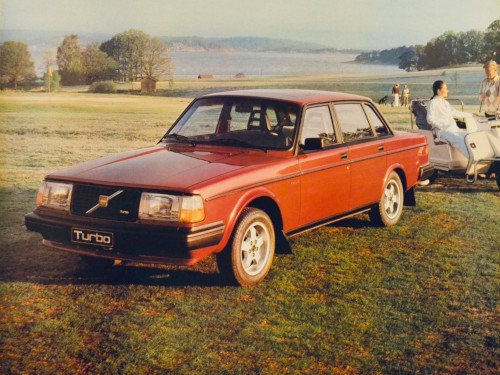
1981 – Volvo 240 GLT & Volvo 240 Turbo on Lyckorna Golfklubb at Anfasteröd Golfanläggning on Anfasterödsvägen in Ljungskile, Sweden 🇸🇪.

1981 – Volvo 245 GLT & Volvo 244 Turbo on Lyckorna Golfklubb at Anfasteröd Golfanläggning on Anfasterödsvägen in Ljungskile, Sweden 🇸🇪.

1981 – Volvo 264 & 245 on Lyckorna Golfklubb at Anfasteröd Golfanläggning on Anfasterödsvägen in Ljungskile Sweden 🇸🇪.

1996 – Volvo 850 GLT at Tuvesvik Hamn with view on Gullholmen on Orust in Sweden 🇸🇪.

1992 – Volvo 850 GLT at Tuvesvik Hamn with view on Gullholmen on Orust in Sweden 🇸🇪.

1974 – Volvo 144 de Luxe and 145 de Luxe on Angeredsleden E45 towards Agnesbergsmötet in Göteborg, Sweden 🇸🇪.

1996 – Volvo 960 at Glimmingehus on Borgvägen in Hammenhög, Sweden 🇸🇪.

1984 – Volvo 240 & Volvo PV544 from 1959 at Whiskey Distillery in High Chaparral Western Theme Park in Kulltorp, Småland in Sweden 🇸🇪.

1975 – Volvo 264 GL at Whiskey Distillery in High Chaparral Western Theme Park in Kulltorp, Småland in Sweden 🇸🇪.

1975 – Volvo 264 GL at Kate’s Palace in High Chaparral Western Theme Park in Kulltorp, Småland in Sweden 🇸🇪.

1975 – Volvo 264 GL at Dalton City in High Chaparral Western Theme Park in Kulltorp, Småland in Sweden 🇸🇪.

1972 – Volvo 144 at Hotell Rubinen on Avenyn in Göteborg 🇸🇪.

1968 – Volvo Amazon at Åbergs Skor on Avenyn 32 and Engelbrektsgatan in Göteborg 🇸🇪.

1972 – Volvo 142 at Fiskebäck Marina on Hälleflundregatan in Västra Frölunda in Göteborg 🇸🇪.

1972 – Volvo 142 Basic on Packhusgatan near Packhusplatsen in Göteborg Sweden 🇸🇪.

1977 – Volvo 66, 343, 244 and 264 at Kronhuset between Kronhusgatan and Postgatan in Göteborg 🇸🇪.

1977 – Volvo 66, 343, 244 and 264 at Kronhuset between Kronhusgatan and Postgatan in Göteborg 🇸🇪.

1978 – Volvo 343 on Västra Sjöfarten near Packhusplatsen in Göteborg, the building on the left is replaced by the Operahouse of Göteborg 🇸🇪
(Thank you Per Richardson for finding this location!)

1988 – Volvo 780 at Best Western Plus Hotel Waterfront at Klippan on Adolf Edelsvärds gata in Göteborg, Sweden 🇸🇪

1968 – Volvo 145 at Frölunda torg shopping center in Järnbrott, Göteborg 🇸🇪

1973 – Volvo 145 Taxi at Infektionsmottagningen at Östra Sjukhuset Sahlgrenska on Journalvägen 10 in Göteborg, Sweden 🇸🇪

1979 – Volvo 244 and 245 at Alingsåsleden E20 in Göteborg 🇸🇪.

1967 – Volvo Amazon at Västra Hamngatan in Göteborg 🇸🇪.

1978 – Volvo 244 DL Taxi on Västra Hamngatan, in the direction of Norra Hamngatan, Göteborg 🇸🇪.

1972 – Volvo 164 at Partille kommun Social- & arbetsförvaltningen on Gamla Kronvägen 34 in Partille near Göteborg 🇸🇪

1972 – Volvo 164 at Partille kommun Social- & arbetsförvaltningen on Gamla Kronvägen 34 in Partille near Göteborg 🇸🇪.

1972 – Volvo 164 at Partille kommun Social- & arbetsförvaltningen on Gamla Kronvägen 34 in Partille near Göteborg 🇸🇪.

1967 – Volvo Amazon at Prismahallen Cafetaria on Norra Dragspelsgatan 20 in Frölunda, Göteborg 🇸🇪.

1972 – Volvo 164E US-version at Västerleden towards Älvsborgbron or Älvsborg bridge in Göteborg Sweden 🇸🇪.

1965 – Volvo 121 122 S at E6 Kungsbackaleden at Olskroken in Göteborg, Sweden 🇸🇪.

1966 – Volvo P220 inside Frölunda torg shopping center in Göteborg 🇸🇪

1934 – Volvo TR 671 Taxi on Västervikstorget in Strängnäs, Sweden 🇸🇪.

1964 – Volvo 544a under the Älvsborgsbron (under construction) in Göteborg, Sweden 🇸🇪.

1995 – Volvo V40 at Blå Hallen Teater and Quality Hotel 11 on Maskingatan in Västra Eriksberg in Göteborg 🇸🇪 (Photography by Claes Axstål)

1969 – Volvo 164 at Volvohallen on Gunnar Engellaus väg in Göteborg 🇸🇪

1972 – Volvo VESC at Lysegårdens Golfklubb on Lysegården in Romelanda, Sweden 🇸🇪.

1972 – Volvo VESC at Lysegårdens Golfklubb on Lysegården in Romelanda, Sweden 🇸🇪.

1972 – Volvo VESC at Lysegårdens Golfklubb on Lysegården in Romelanda, Sweden 🇸🇪.

1975 – Volvo 244 DL at Stenstugan on Säby Island in Tjörn Sweden 🇸🇪.

1991 – Volvo 940 Turbo at Volvo Cars Visitor Center and Volvo Factory Delivery Center on Karossvägen on Hisingen in Göteborg, Sweden 🇸🇪.

1946 - Volvo PV60 Prototype at Näckrosdammen in Göteborg

1946 – Volvo PV60 Prototype at Näckrosdammen in Göteborg

1965 – Volvo Duett P210 at a Parken Eskilstuna, nowadays called Parken Zoo in Eskilstuna, Sweden. The little elephant in the photo could have been the Asian elephant Merry. Merry was a prize in a competition, by AB Bjäre Industrier in Karpalund near Kristianstad, which produced a Swedish soft drink called Merry, and where the winner could win the elephant Merry or a Rolls-Royce if collected caps. The winner of the elephant refused to own the elephant Merry, which in 1964 ended up in Parken Zoo in Eskilstuna and was sold on to an unknown location between 1967 and 1969.

1958 – Volvo PV445 from Sko Åberg on Klamparegatan in Göteborg, Sweden 🇸🇪.

1985 – Volvo 240 GL Estate near Skivarps windmill on Kyrkvägen in Skivarp, Skåne, Sweden 🇸🇪.

1985 – Volvo 240 GL Estate near Skivarps windmill on Kyrkvägen in Skivarp, Skåne, Sweden 🇸🇪.

1968 – Volvo P210 Duett at Bygg Drive-in at Domus Stormarknad on Backavägen 8 in Göteborg Sweden 🇸🇪.

1968 – Volvo P210 Duett at Bygg Drive-in at Domus Stormarknad on Backavägen 8 in Göteborg Sweden 🇸🇪.

1968 – Volvo P210 Duett at Bygg Drive-in at Domus Stormarknad on Backavägen 8 in Göteborg Sweden 🇸🇪.

1968 – Volvo P210 Duett at Bygg Drive-in at Domus Stormarknad on Backavägen 8 in Göteborg Sweden 🇸🇪.

1977 – Volvo 264 GLE at Lito corner on Ring Knutstorp on Knutstorpvägen in Kågeröd in Sweden 🇸🇪.

Volvo Photo Locations
bookmark www.volvophotolocations.com today!

Swedish Cyprus Expedition with Volvo ÖV4 (1927 – 1931)

May 6th, 2018

The Swedish Cyprus Expedition was a project to systematically investigate the archaeology of the early history of Cyprus. It took place between September 1927 and March 1931 and was led by three archaeologists Einar Gjerstad, Erik Sjöqvist, Alfred Westholm and architect / photographer John Lindros.
1930 – The Swedish Cyprus Expedition core team with John Lindros, Alfred Westholm, Erik Sjöqvist and Einar Gjerstad

Archaeological excavations were made at various locations in Cyprus including Lapithos, Nitovikla, Ajia Irini and Enkomi. The results were published in four volumes from 1934 to 1972. Most of the finds are now kept at the Cyprus Museum in Nicosia and Medelhavsmuseet in Stockholm.

In total, 30 sites and 375 graves were excavated. The Expedition’s Cypriotic driver and assistant, Tooulis Souidos, followed the expedition to Sweden where he continued to work with the Cyprus collections.

1927-1931 – Volvo ÖV4 at Svenska Institutet in Nicosia Cyprus

Einar Gjerstad had in two rounds between 1923-1924 conducted preliminary archaeological surveys in Cyprus, which resulted in the dissertation Studies on Prehistoric Cyprus, 1926. The following year, in 1927, Gjerstad proposed that a more extensive archaeological project, with Cyprus as a research area, should be organized . On the initiative of Gjerstad, the so-called Swedish Cypriot Committee was formed the same year, with the purpose of organizing an archaeological expedition to the Mediterranean Sea, as well as financially supporting the expedition in the field.

1927-1931 – Volvo ÖV4 on day trip to Limassol at stop with Amathus Agios Tychos

The committee consisted of Crown Prince Gustaf Adolf (Chairman), Sigurd Curman (Secretary), Johannes Hellner (Treasurer), Martin P. Nilsson and Axel W. Persson. Financing of the expedition was largely due to private donors, and Gjerstad succeeded, among other things, in receiving a few contributions from financier Ivar Kreuger.

Gjerstad was also allowed to borrow one of the first Volvo cars in production, a Volvo ÖV4. The car was probably number three in the series called ‘Jacob’, and was delivered in 1927. The Volvo performed overwhelmingly well and was able to be carried on Cyprus’s rugged donkey roads in a breathtaking speed of 60 km/h. The automobile Jacob probably meant a lot for the efficiency of the expeditions work. On old films, you see how tall statues in terracotta shake and rumble on the Volvo’s backseat during different transports. In front of larger expeditions to different parts of the island, the car was so packed with supplies that it barely could be seen under tents, camera equipment, suitcases, etc. Where the Volvo could not be used, there used camels and donkeys.

1927-1931 – Volvo ÖV4 advertisement with car and camels (combined photo)

Einar Gjerstad was appointed as project manager and John Lindros, Erik Sjöqvist and Alfred Westholm were appointed as assistants. Gjerstad was responsible for the organization of the expedition while Sjöqvist and Westholm were responsible for the archaeological field work. Lindros was responsible for drawings and photographs.

The main purpose of the expedition was to investigate and, in the long run, gain increased knowledge of ancient Cyprus’s archeology and history from rock age through late Roman times, a period of more than fifty thousand years. In order to achieve this purpose, the expedition was organized as a highly flexible and moving company, with the whole of Cyprus as its research area.

In September 1927, the expedition departed from Stockholm. They were invited by Sweden’s consul in Cyprus.

Lapithos (autumn 1927-spring 1928)
In northern Cyprus lies the village of Lapithos. Near this place is a large burial place from the Bronze Age (about 2000-1800 BC) with hundreds of graves. The expedition’s excavations here 1927-28 resulted in lots of ceramics and weapons in copper and bronze.

Volvo ÖV4 on a small road in Kythrea

Enkomi (June-July 1930)
The big city of Enkomi in eastern Cyprus was an important metropolis during the late Bronze Age with copper workshops, craft quarters and sanctuaries. Here, a necropolis with rich graves from the late Bronze Age (1200s BC) was examined with gold, silver and ivory objects, as well as hundreds of vases. The tombs were under the houses, which were dug out later by Cypriot and French archaeologists.

1927-1931 – Volvo ÖV4 at Camp Oura

Kition (October 1929-April 1930)
The Swedish Cyprus Expedition’s excavations in Kition began in October 1929 and continued until April 1930, with a break during the winter season.

1927-1930 – Volvo ÖV4 at domed fountain place in Pólis / Marion on Cyprus

Ajia Irini (November 1929)
Many important archaeological sites have been identified by excavators. The cult spot at Ajia Irini on the northwestern coast of Cyprus was one such. During the summer of 1929 the expedition received a visit by a priest, Papa Prokopius. He had erupted a thief digger on his belongings by the village of Ajia Irini. The priest decided to transfer the excavation right to the Swedish archaeologists. The place proved to be an unspoiled sanctuary used more or less continuously since about 1200 BC. But the most important period and most finds are dating to about 650-500 BC. An army of terracotta figures hid half a meter below the sandy soil. The 2000 figures lay and stood, grouped in the form of a semicircle, much like a theater. There were clergy, warriors and ordinary Cypriots. Most statues are a couple of decimeters high or less. Many carry offerings, dance or play musical instruments to the glory of God. However, several statues are of natural size. Impressive is the so-called sacrifice priest, wearing long clothes and turban. According to the excavators, he should have kept a sacrificial knife in his raised left hand. Models of tanks with horses, multiple-figure bulls symbolize God’s male power and fertility.

1927-1930 – Volvo ÖV4 from Svenska Cypern Expeditionen

Vouni
The ancient wall of Vouní on the castle cliff (Vounó means mountain in Greek) 270 meters above sea level on the northwestern coast of Cyprus, overlooking Petra, is the site of a monumental palace. The palace was used for more than a hundred years and was rebuilt several times during the 500 / 400s BC. The architects were influenced by both oriental and Greek architecture. There are no sources or fresh water at Vouní, but in the middle of the big palace there was a large cistern where rainwater from the roof could accumulate. One of the items found here during the Swedish Cyprus Expedition in 1928 was the Vouni head. It has the typical archaic smile, is easily triangular and with a characteristic calathosis in the hair. A kalathos is a kind of diadem with different motifs. Vouni heads diadem consists of dancing figures and rosettes. This smile is useful for dating and places the sculpture at about 600-500 BC. The Vouni head is also one of the more central objects in the Cyprus Exhibition at the Medelhavsmuseet in Stockholm.

Vouni expedition packing outside Svenska institutet in Nicosia their Volvo ÖV4

Vouni expedition packing outside Svenska institutet in Nicosia their Volvo ÖV4

Petra tou Limniti (1929)
Petra tou Limniti is a small rock island on the western part of Cyprus’s north coast, about 100 meters from the coast. The expedition came to be interested in the island during the excavations of Vouni. Here you found the top of the island cultural heritage that was dating to the Stone Age. During one day at harvest time in 1929, excavations were carried out and identified four building periods.

Volvo ÖV4 at cafe in Pyrgos

In the winter of 1931 the excavations were over and the money ended. In accordance with the legislation in force, the findings were shared between Cyprus and Sweden and more than half of the find came to Sweden. The total amount of finds from the excavations amounts to about 18,000 objects. Of these, Sweden received about 12,000. In addition, there is a large cutting material stored in 5,000 shock cartons in the Medelhavsmuseet in Stockholm’s magazine. The find was packed in 771 wooden boxes and was taken to Sweden in March 1931. The transport took one year on one of the Swedish Orient Line ships.

Volvo ÖV4 on Cyprus – problems with the car

1927-1931 – Volvo ÖV4 with flat tire

For several years, the Cyprus collections were kept in the Krubban quarter in the Oxenstiernska ore farm. They were completely untempered and the climate change became very dramatic. Many unique items were destroyed. Stone sculpture and ceramics burst into the strong cold. 1930s press clippings describe the difficult situation. In 1942, the History Museum in Stockholm published a number of items from the Swedish Cyprus Expedition in the exhibition “Before Fidias”.

1931 – Einar Gjerstad with golden box to be send home in Sweden

All photos during the Swedish Cyprus Expedition were made by John B. Lindros (August 3, 1898 Vaxholm, Sweden – December 2, 1961 Nyköping, Sweden). He was a Swedish architect and photographer.
During his studies at the Royal Institute of Technology in Stockholm (1923–1925), Lindros was employed by the Nordic Museum and Skansen to study buildings around Sweden. He graduated in 1924. One of his study mates was Alfred Westholm, who later recruited him to the Swedish Cyprus Expedition.

During the expedition in Cyprus (1927–1931), Lindros worked as architect, responsible for measuring and drawing the many maps, plans and sections that are the result of an archaeological excavation. He also worked as a photographer and took an enormous amount of pictures of the excavations. He photographed when SF Studios produced a newsreel about the Swedish Cyprus expedition. As Alfred Westholm himself had experience in photographic and topographic work, Lindros worked mostly in Erik Sjöqvist’s excavation team. When Sjöqvist was ill, Lindros temporarily took over the excavation in Idalion, Cyprus. He was also interested in documenting Cypriot folklore and visited many remote villages with his camera. John’s wife Rosa Lindros followed him to Cyprus and stayed there until June 1928. She also participated in restoration of the archeological findings.

Along with expedition leader Einar Gjerstad, John Lindros was responsible for unpacking the archaeological materials after returning to Sweden. He worked with the other expedition members on the major scientific publication, The Swedish Cyprus Expedition: Finds and Results of the Excavation in Cyprus 1927-1931, volume I, volume II, volume III.

From 1933–35 John Lindros served as assistant at the Swedish Institute in Rome. He then worked at Byggnadstyrelsen in 1936, Svenska Köpmannaförbundet 1936–1937, and the insurance company Liv-Thule 1937–1940. After that Lindros had his own company. In 1944 he was employed at the Västerås county architectural office and in 1947 he became deputy county architect in Södermanland, Sweden.

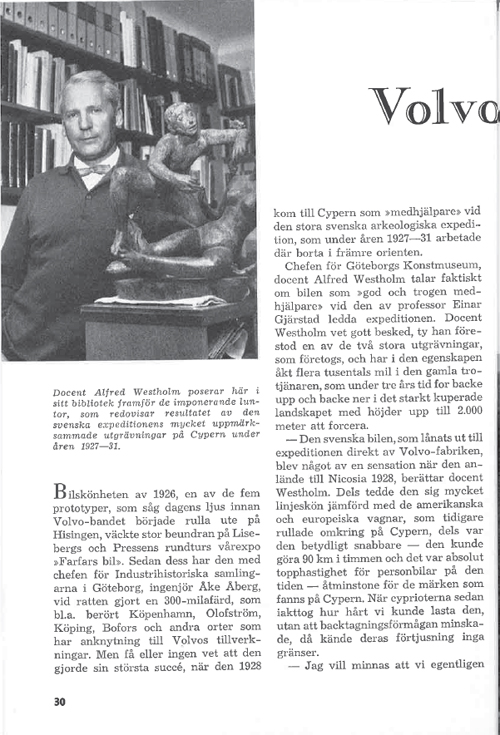
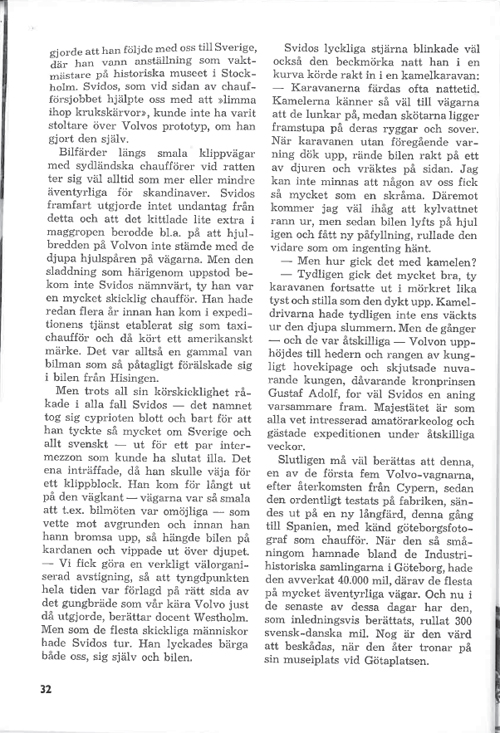
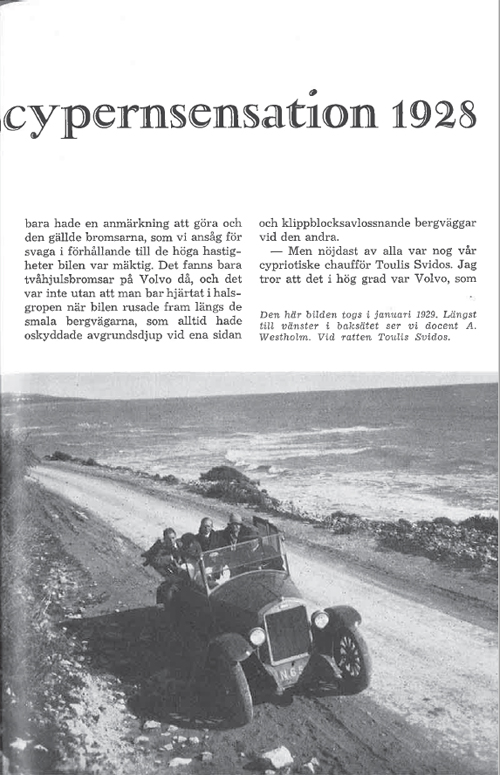
In February 1960, the Volvo magazine Ratten had an article on the Volvo ÖV4 and its adventure on Cypress:

More information at: Facebook, sv.wikipedia.org/Svenska_Cypernexpeditionen, en.wikipedia.org/John_Lindros

Masthuggskyrkan on Storebackegatan in Göteborg 🇸🇪

April 1st, 2018

Volvo Photo Locations Part 302
Historic Volvo Photography Locations Overview
bookmark www.volvophotolocations.com today!

1926 – Volvo ÖV4 at Masthuggskyrkan in Göteborg 🇸🇪

2017 – Volvo XC60 on Stigberget near Masthuggskyrkan on Storebackegatan in Göteborg 🇸🇪

2018 – Storebackegatan near Masthuggskyrkan in Göteborg (Google Streetview)

2018 – Storebackegatan near Masthuggskyrkan in Göteborg (Google Streetview)

Storebackegatan is a street on Stigberget in Göteborg. This place is mostly known because of the Masthuggskyrkan, but from here, you als get a great view over Göteborg with the Göta Älv.

Masthuggskyrkan is a well-known church in Göteborg, Sweden, which was built in 1914. Its position on a high hill (Masthugget) close to the city and near the Göta älv makes it a striking sight – the church tower is 60 m high in itself. The church represents the national romantic style in Nordic architecture and was designed by Sigfrid Ericson. The church, which has become one of the symbols of Göteborg, is a popular tourist attraction.

More information at sv.wikipedia.org and www.goteborg.com.

Volvo Photo Locations