home

[ Content | Sidebar ]

Zara on Av Diagonal in Barcelona – ES 🇪🇸

April 7th, 2013

International Volvo Photo Locations Part 103
Historic Volvo Photography Locations Overview

2010 - Volvo C30

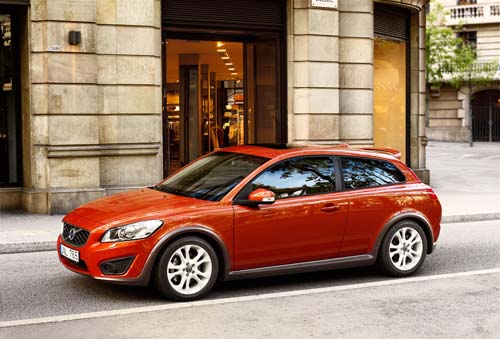
2010 – Volvo C30 at Zara on Av Diagonal in Barcelona, Spain 🇪🇸.

2010 - Volvo C30

2010 – Volvo C30 at Zara on Av Diagonal in Barcelona, Spain 🇪🇸.

2013 - Zara at Av Diagonal in Barcelona Spain

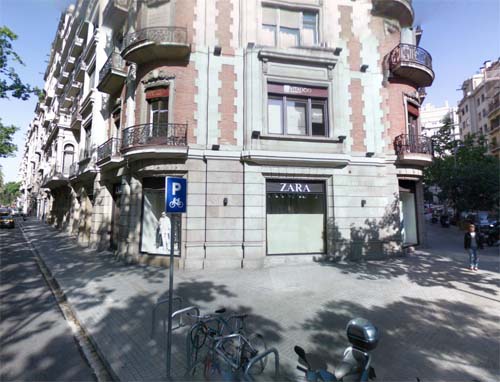
2013 – Zara at Av Diagonal in Barcelona Spain (Google Streetview)

Avinguda Diagonal is the name of one of Barcelona’s broadest and most important avenues. It cuts the city in two, diagonally from west to east (by Barcelona’s compass), hence the name.

It was originally projected by engineer and urban planner Ildefons Cerdà as one of the city’s wide avenues, which along with Avinguda Meridiana would cut the rationalist grid he designed for l’Eixample (Catalan for extension). Both would meet at Plaça de les Glòries Catalanes, which Cerdà envisioned as the new city centre. However, Plaça Catalunya, equally a new addition to the city of Barcelona, and connecting Ciutat Vella and Eixample, and therefore occupying a more privileged position in the urban area, would finally become the centre. Avinguda Diagonal remains to this day a much-transited avenue and many companies and hotels use it as a privileged location, as can be seen in its architecture.

The avenue starts in the Sant Martí district, next to Ronda del Litoral, bordering Sant Adrià de Besòs, and crosses the city, finally meeting the Lleida-Madrid highway and Ronda de Dalt, by Esplugues de Llobregat, in Les Corts. It is consistently 50 meters wide and about 11 kilometers long.

Avinguda Diagonal suffered several attacks by the Basque separatist organisation ETA in 2000. On November 2, a car bomb exploded injuring a security officer and a municipal officer. A few days later, on November 21, a car used by the killers of Enerst Lluch exploded in the middle of the avenue. On December 20 a municipal officer was shot dead.

Four venues in the area hosted competitions for the 1992 Summer Olympics.

During 2010, Diagonal reform proposals were on the headlines, as the Barcelona city council had plans to make the tram cross the whole avenue. A popular consultation (the word referendum being banned by Spanish law) was scheduled for May 2010 between two reform proposals, the so called rambla or boulevard. It resulted in a big political failure for the city mayor, Jordi Hereu. There was a bare participation of 12% of potential voters, and about 80% voted for the third option none of the former two, that is, against any change.

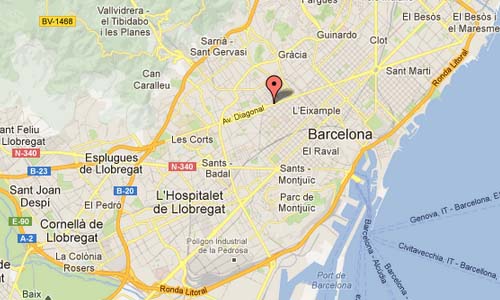
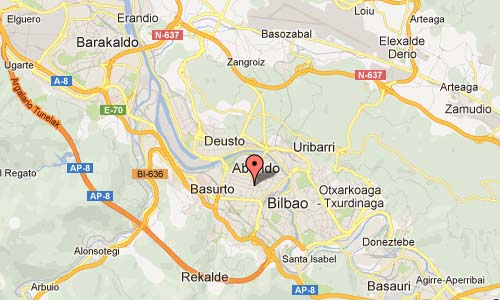
Av Diagonal Barcelona Map

More information at en.wikipedia.org

Historic Volvo Photography Locations Overview

Innoprot Office at Parque Tecnologico de Bizkaia at Arteaga Auzoa in Elexalde Deno – ES 🇪🇸

April 7th, 2013

International Volvo Photo Locations Part 102
Historic Volvo Photography Locations Overview

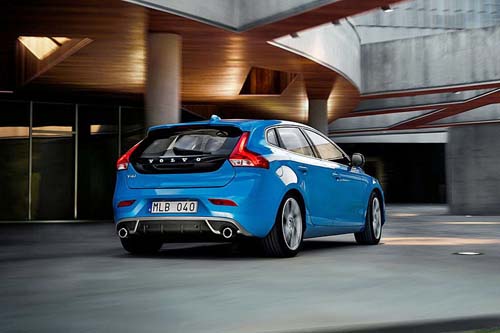
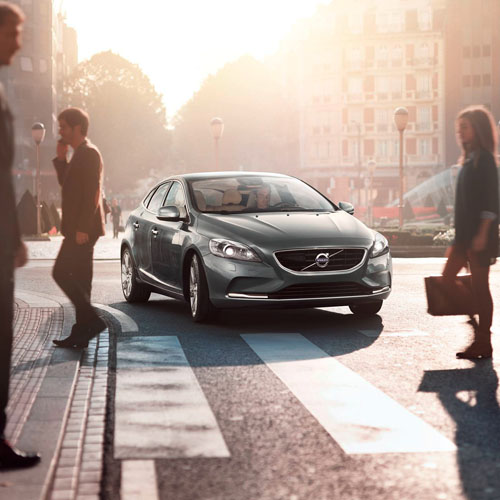
2013 - Volvo V40 R-Design

2013 – Volvo V40 R-Design at Innoprot Office at Parque Tecnologico de Bizkaia at Arteaga Auzoa in Elexalde Deno, Spain 🇪🇸.

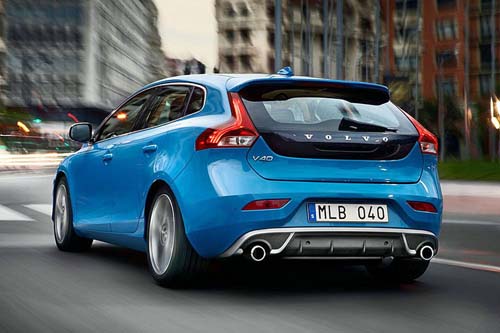
2013 - Volvo V40 R-Design

2013 – Volvo V40 R-Design at Innoprot Office at Parque Tecnologico de Bizkaia at Arteaga Auzoa in Elexalde Deno, Spain 🇪🇸.

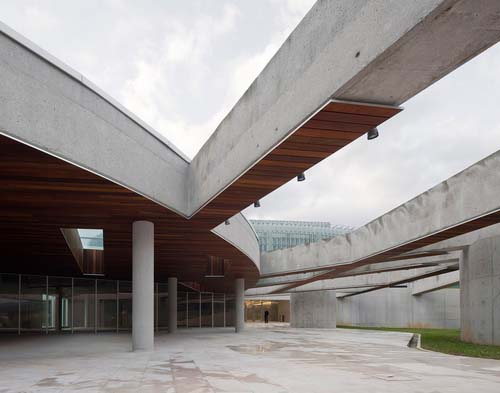
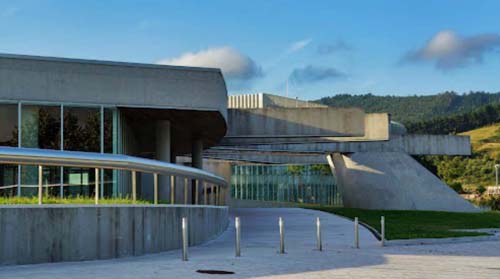
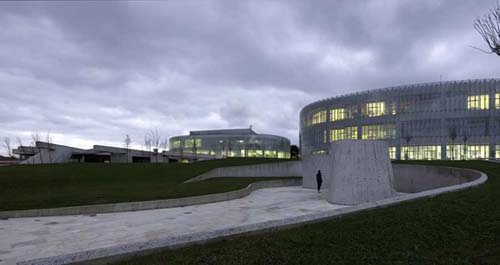
2013 - Innoprot Office at Parque Tecnologico de Bizkaia at Arteaga Auzoa in Elexalde Deno near Bilbao Spain

2013 – Innoprot Office at Parque Tecnologico de Bizkaia at Arteaga Auzoa in Elexalde Deno near Bilbao Spain

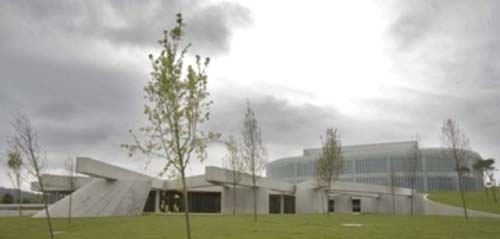
2013 - Arteaga Auzoa in Elexalde Deno near Bilbao Spain

2013 – Arteaga Auzoa in Elexalde Deno near Bilbao Spain

Parque Tecnológico de Vizcaya (or Technology Park Association S.A.) attached to the Basque Government’s Department of Industry, Commerce and Tourism is a technology parc close to Bilbao. Built in 2009 in Derio.

The Technology Park is a center of high technology industries turning 25 years in 2010. For the last phase of its industrial growth, it has been decided to build two new buildings for research and production of, respectively, computing and biotechnology. Both of them should work in complete independence, although the plan was considered in a unified way.

The model submitted to the competition proposed, with cedar, ebony and lemongrass, two soft insertions, no rough edges, lacking rotunda geometry (they are not circles or ellipses, or ovals), whose perimeters should not be crossed even for access.

2013 - Innoprot Office at Parque Tecnologico de Bizkaia at Arteaga Auzoa in Elexalde Deno near Bilbao Spain

They are two compact buildings with a ductile envelope, as a mass of grass or a plant stem, which could have existed prior to the delineation of the road. The compactness and the façade of brushed planes allows to the eye of the moving beholder (the driver on the road, pedestrians on the sidewalks) to smoothly surround the objects.
The façade is a double ventilated skin that allows breath the building. It connects the interior and exterior and is capitalizing energy, climatic, hygienic and space for such an exchange. The space between the two membranes gives users a place of permanent relationship with the outside.

software biotechnology plant

This façade is actually a vertical volume of air that accompanies its full height, and provides natural light to both sides of the outer skin. It is a façade for North mist. Its light is here the mist light, without shadows. It is a continuous and weak material. The buildings lose their boundaries and do not hurt the light.

Each user will occupy the interior according to their needs. But the construction of the façade will remain, and with it the most accurate, longer lasting elements. The concrete is exposed with its most naive and raw sincerity. Glass sun visors are fixed with untreated stainless steel plates. Construction is a «no preservatives» one.

The exterior glass, which supports a soft pencil handmade drawing, provides a very silky one way look, and completely open on the contrary.

(Text by Coll Barreu Arquitectos)

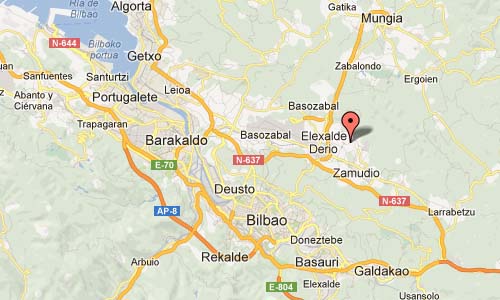
Parque Tecnológico de Vizcaya Map

More information at www.parque-tecnologico.es and www.coll-barreu-arquitectos.com

Historic Volvo Photography Locations Overview

Plaza Moyua in Bilbao – ES 🇪🇸

April 7th, 2013

International Volvo Photo Locations Part 101
Historic Volvo Photography Locations Overview

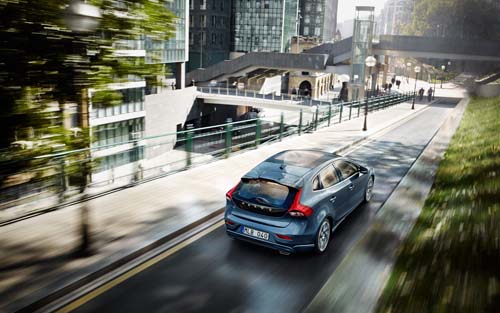
2015 - Volvo V40

2015 – Volvo V40 on Plaza Moyua in Bilbao, Spain 🇪🇸.

2012 - Volvo V40

2012 – Volvo V40 on Plaza Moyua in Bilbao, Spain 🇪🇸.

2013 - Volvo V40 R-Design

2013 – Volvo V40 R-Design on Plaza Moyua in Bilbao, Spain 🇪🇸.

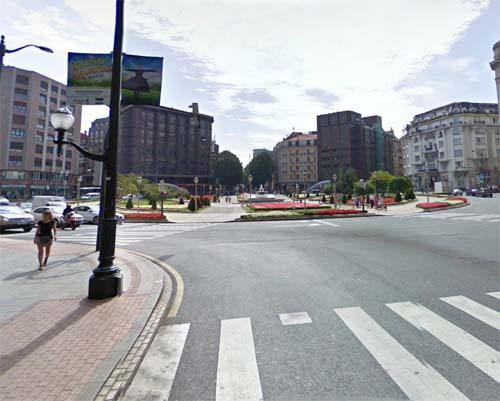
2013 - Plaza Moyua in Bilbao Spain (Google Streetview)

2013 – Plaza Moyua in Bilbao Spain (Google Streetview)

Plaza Moyúa is a square in central Bilbao, Spain. Moyúa or the Elliptic square is a public square located in the center of Bilbao’s extension, in the district of Abando. The square was conceived in 1876 as a central hub in the middle of Gran Vía de Don Diego López de Haro avenue, from where the main eight streets depart in radius-like shape and was merely called Elliptic Square because of its form. The square was refurbished in the 1940s to adopt its current form, with a central fountain and several gardens in French and English styles, and was renamed to honour a former mayor of the city, Federico Moyúa.

Plaza Moyua in Bilbao from the air

The square as is today was totally rebuilt in 1997 after six years of works to build the Bilbao Metro. Moyua metro station (spelt without accent) is the closest to the famous Guggenheim Museum. Trains on both lines 1 and 2 call at the station, sharing the same tracks and platforms. It is also the terminus for Bilbobus routes 1 and 76.

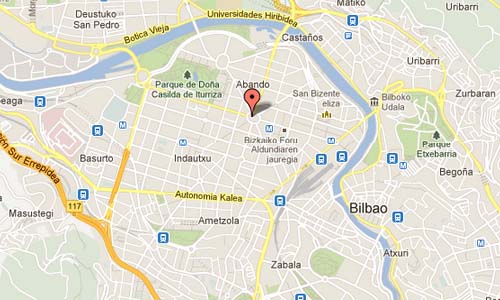
Plaza Moyua - Bilbao Map

More information at en.wikipedia.org

Historic Volvo Photography Locations Overview

Uribitarte Kalea in Bilbao – ES 🇪🇸

April 7th, 2013

International Volvo Photo Locations Part 100
Historic Volvo Photography Locations Overview

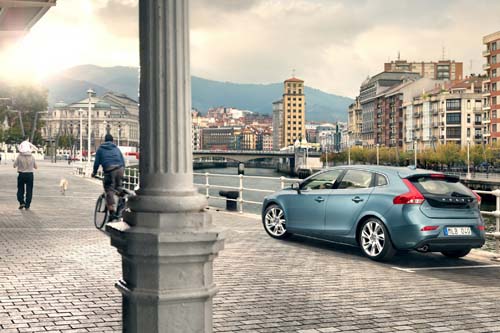
2012 - Volvo V40

2012 – Volvo V40 at Uribitarte Kalea in Bilbao, Spain 🇪🇸.

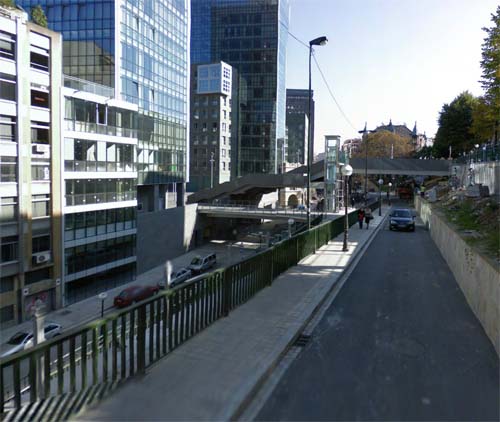
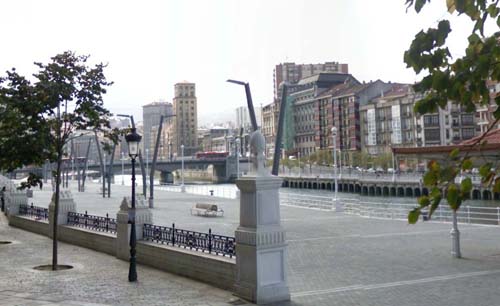
2013 - Uribitarte Kalea in Bilbao, Spain (Google Streetview)

2013 – Uribitarte Kalea in Bilbao, Spain (Google Streetview)

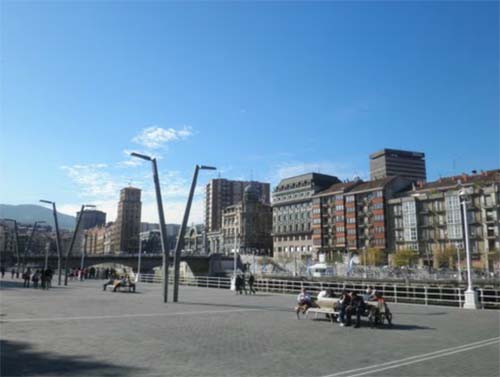
Uribitarte Kalea is a street in Bilbao, Spain.

The area of Uribitarte adjoins the River Nervión and the left-hand extension of the city of Bilbao. It was once an island separated from the Abando plain by a branch of the river. After the definitive extension of the city at the end of the nineteenth century, Uribitarte ceased to be the island that it had once been geographically to become a continuous superficial extension that underwent a number of transformations over the years in keeping with the urban development of Bilbao.

A river walk was formalised the entire length of the old docks development, from the left bank of the river right up to the built-up area between the La Naja district and the Guggenheim Museum. This promenade part of the project defined five clearly differentiated spaces: a docks space next to the river, a pedestrian tree-lined footpath half a metre above the docks area, a central green garden area over part of which the new tramline was to pass, a boulevard for ring-route traffic that, as a continuation of the street planned for the Andoibarra area, adopts the same character of a low-velocity thoroughfare, and a new five-metre-wide pavement going right up to the buildings in order to intensify the use of ground-floor premises that face on to the river. Work will also take into account connections with the footbridge that was constructed in recent years.

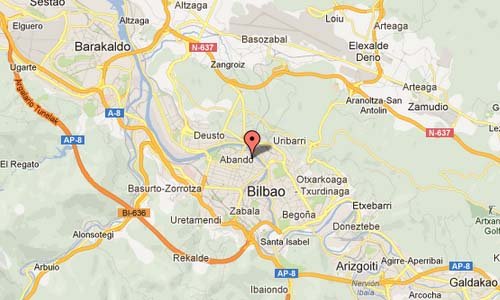
Uribitarte Kalea Bilbao Map

More information at www.publicspace.org

Historic Volvo Photography Locations Overview

Arenal Ibilbidea on Areatzako Pasealekua in Bilbao – ES 🇪🇸

April 7th, 2013

International Volvo Photo Locations Part 99
Historic Volvo Photography Locations Overview

2013 - Volvo V40

2013 – Volvo V40 at Arenal Ibilbidea on Areatzako Pasealekua in Bilbao 🇪🇸

2013 - Arenal Ibilbidea in Bilbao, Spain (Google Streetview)

2013 – Arenal Ibilbidea on Areatzako Pasealekua in Bilbao, Spain (Google Streetview)

2013 - Arenal Ibilbidea in Bilbao, Spain

2013 – Arenal Ibilbidea in Bilbao, Spain

2013 - Arenal Ibilbidea in Bilbao, Spain

2013 – Arenal Ibilbidea in Bilbao, Spain

Arenal Ibilbidea is a carfree street along tha banks of the river in Bilbao, Spain. It is close to the Arenal Bridge, which is a reinforced concrete bridge in Bilbao, Spain. It spans the Estuary of Bilbao, linking the neighborhoods of Casco Viejo and Abando.

Along with the growth of Bilbao, the urban centre of the city expanded beyond the old original seven streets, and started to expand over territories of the, by that time, elizate of Abando. In fact, the transit of people moving from Abando to Bilbao or from Bilbao to Abando grew every year and became more fluid. As the only bridge that crossed the Estuary of Bilbao was the San Antón Bridge, it became a necessity and a priority to build a new bridge that would connect both banks of the river.

On the banks, you find the Kiosko del Arenal. The “Kiosko del Arenal” was reconstructed in 1985, the original one was built in 1923. Several bands play concerts in this Kiosk, especially the Bilbao Town Band. The Kiosk sits in a park in front of the river.

Arenal Ibilbidea in Bilbao Map

More information at en.wikipedia.org

Historic Volvo Photography Locations Overview

Osakidetza Delegación Territorial de Sanidad y Consumo de Bizkaia on Poza Lizentziatuaren Kalea in Bilbao – ES 🇪🇸

April 7th, 2013

International Volvo Photo Locations Part 98
Historic Volvo Photography Locations Overview

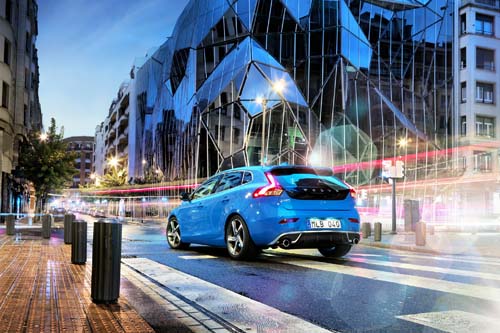
2013 - Volvo V40 R-Design

2013 – Volvo V40 R-Design at Osakidetza Delegación Territorial de Sanidad y Consumo de Bizkaia on Poza Lizentziatuaren Kalea in Bilbao, Spain 🇪🇸.

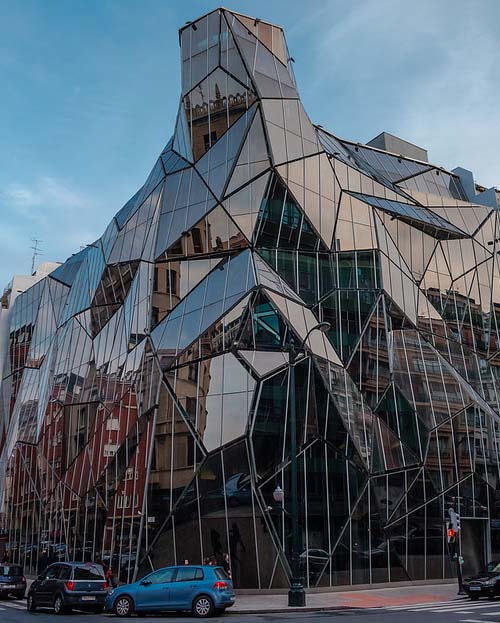
2013 - Osakidetza in Bilbao Spain

2013 – Osakidetza Delegación Territorial de Sanidad y Consumo de Bizkaia on Poza Lizentziatuaren Kalea in Bilbao Spain

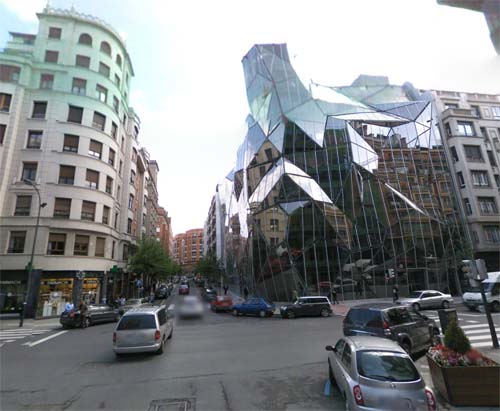
2013 - Osakidetza on Calle Licenciado Poza in Bilbao, Spain (Google Streetview)

2013 – Osakidetza on Calle Licenciado Poza in Bilbao, Spain (Google Streetview)

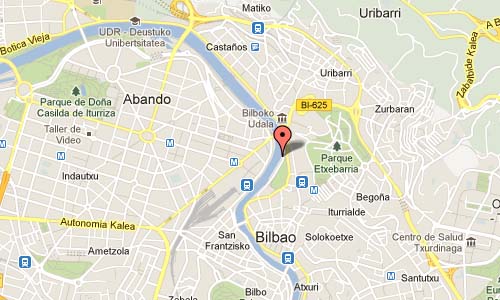
The Basque Health Department Headquarters are located at Calle Licenciado Poza in central Bilbao, Spain.

The river of Bilbao is not the only area where urban renewal is taking place. In the center of the old town, the Basque Government has commissioned the young Basque architect Juan Coll-Barreu to design a ‘vital’ building, dominantly present on the corner of Calle Licenciado Poza with La Alameda de Rekalde.

The works of this architect are characterized by their adaptive nature, like a glove fits to a hand. All conditions and circumstances are taken into account: first the urban context, the client’s wishes, the functions of the building, the climate, and finally the project itself. After winning the design competition, this was the first project for him in a complex urban situation: ‘In this design process, everything was a challenge’. The building is bold and transparent, to express the healty image of Bilbao, and the vital works of its occupants: the Department of Public Health. A double glazed facade functions as a warm blanket in the winter, and a natural membrane in summer.

Osakidetza in Bilbao Map

More information at www.coll-barreu-arquitectos.com

Historic Volvo Photography Locations Overview

Ruud van Empel in Fotografiska

April 4th, 2013

Exhibition of Dutch photographer Ruud van Empel: Pictures don’t lie.

At Fotografiska Museum in Stockholm from March 9 – June 2, 2013

In the past few years Ruud van Empel (Breda, 1958) has developed into one of the most extraordinary photographic artists of the present day, both nationally and internationally.

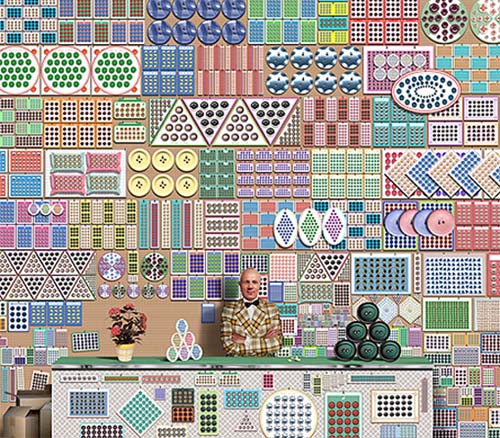
After completing his education at the Academie Sint Joost in Breda (1976-1981), Ruud van Empel worked as a designer on many projects, including theatre and television, for quite some time. His best-known work from that period includes designs for the film Theo en Thea en de ontmaskering van het tenenkaasimperium (See YouTube) (1989) and for the legendary television series Kreatief met kurk (See YouTube) (1993/94). In the second half of the nineties he increasingly began to evolve as an autonomous artist. He started to produce collages in a traditional way, with scissors and a pot of glue, making use of photos from newspapers and magazines. After mastering the computer and Photoshop, he developed an increasingly refined collage technique. At a certain moment, he ceased working with existing material and since then has only made use of his own photos. This exhibition is oriented exclusively to van Empel’s autonomous work.

In his digital handling of photography, van Empel has developed a unique working method. From hundreds of photographic fragments, he compiles images that are genuinely lifelike in their appearance but conjure up a world that has never existed in this form. This paradisaical world is primarily populated by children, as the symbol of innocence, which is one of the major themes of his work. Despite their astounding beauty, these works are far from unequivocal, there is something not quite right: what is real here and what is not? This gives the work of Ruud van Empel a fascinating depth, in addition to the enormous colour splendour and wealth of detail that make it a feast for the eye.

The exhibition presents samples of all the important series that van Empel has created in the past few years, including World, with children posing amid lush greenery or staring at the spectator from a pond, and Moon as its nocturnal counterpart, and Venus, with attractively posing nudes. These series, which have been displayed with great international success in the last few years, are preceded by The Office, with which van Empel began to develop his digital technique from 1995 onward. The exhibition also devotes much attention to his most recent work, Souvenir, with which van Empel added a new, very personal chapter to his oeuvre, and Generation, consisting of panoramic group photos.

Text by Ruud Schenk

MHA Site Office on Hanley Avenue on Crestwood Hills in Brentwood – USA 🇺🇸

March 23rd, 2013

International Volvo Photo Locations Part 97

Historic Volvo Photography Locations Overview

2011 - Volvo S40

2011 – Volvo S40 at MHA Site Office on Crestwood Hills at 990 Hanley Avenue in Brentwood, USA 🇺🇸

2013 - MHA Site Office on Crestwood Hills at 990 Hanley Street in Brentwood, USA

2013 – MHA Site Office on Crestwood Hills at 990 Hanley Avenue in Brentwood, USA

Crestwood Hills is a neighborhood within Brentwood, Los Angeles, California, located on the ridges to the north and east of Kenter Canyon in the Santa Monica Mountains. It is best known for its mid-century modern architecture, and contains several homes designated as architectural landmarks by the State of California. The homes were designed by A. Quincy Jones, and are featured in numerous magazines, articles, and books about mid-century modern housing. The community includes a park, pre-school, and homeowners’ association.

Crestwood Hills began as a utopian experiment in the late 1940s by a few musicians, and eventually turned into a cooperative association that included 400 members. The project was initially called the Mutual Housing Tract, before changing to Crestwood Hills. It was intended as a multi-ethnic project, but pressure on the landowner from existing Brentwood residents – this was still the era of racially and religiously restrictive housing covenants – eventually led to some members of the original group to being dropped as a condition of finalizing the sale. The 1961 Brentwood-Bel-Air fire lead to the destruction of 49 homes. Brenda Rees of the Los Angeles Times said “decades of construction and reconstruction erased much of the original modern design.” By 2000 Crestwood Hills was a wealthy neighborhood.
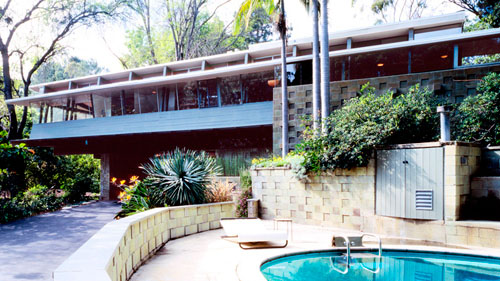
2013 - MHA Site Office on Crestwood Hills at 990 Hanley Street in Brentwood, USA

2013 – MHA Site Office on Crestwood Hills at 990 Hanley Street in Brentwood, USA

The MHA design committee interviewed a number of architects, including Richard Neutra. The final design team was a joint venture between architects A. Quincy Jones and Whitney R. Smith, and structural engineer Edgardo Contini.The master plan uses the rugged terrain to provide a balance of single-family homes, communal facilities, and a public park. The houses are arranged on the hills at varying levels and angles to take advantage of the spectacular views, provide ample space for landscaping, and afford a sense of privacy from one house to another.
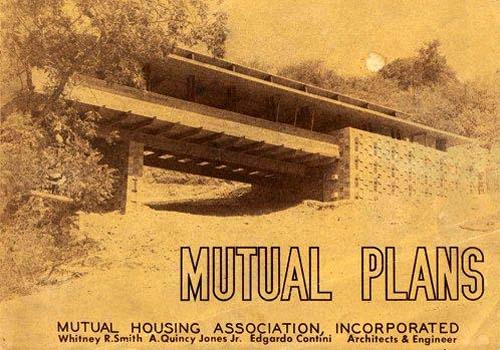
1946 - Cover of the Mutual Housing Association plan

1946 – Cover of the Mutual Housing Association plan

The experimental forms of the MHA houses set a standard for excellence in postwar tract-home development. They are finished with unadorned materials that were readily available after the war: concrete block, exposed Douglas fir plywood, plate glass, redwood siding, and tongue and groove ceiling planks. The houses range from just under 1000 square feet to 1500 square feet, geared to the moderate income family. With thoughtful planning and the use of level changes, the original structures housed a post-war family quite comfortably. Large areas of glass in the walls and sliding doors dissolve the boundary between house and garden. The exposed structural system creates a rhythmic pattern and low-pitched roofs emphasize the horizontality of the structures, securing them comfortably on the gently rolling hills of Crestwood Hills.
Of the 350 residential lots, by 1952 only 160 were built out in accordance with the MHA designs. Two contractors underestimated the complexity of the house plans and went bankrupt, leaving the remainder of the lot owners on their own to hire their own architects and builders. Then, as today, all houses were subject to strict architectural guidelines established by the joint venture, overseen by an Architecture Committee, originally consisting of Jones, Smith, and a layman from the community. The guidelines addressed all building elements such as height of structure, colors, materials, overall design intent, and planting heights; all of which contributed to a cohesive neighborhood.
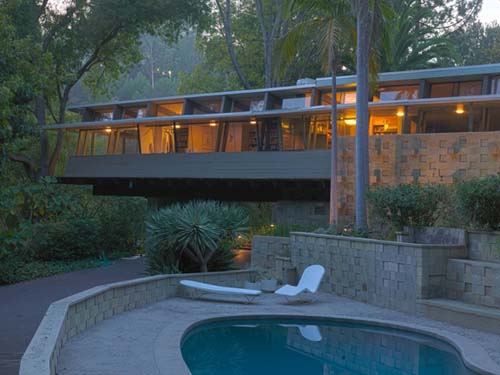
Cory Buckner 11_0

Today, only thirty one of the original MHA houses remain intact. The City of Los Angeles has declared sixteen Historic/ Cultural Monuments and three more will be submitted for monument status by the end of the year.

The existing park, nursery school, and community center, positioned in the best flat land at the center of the tract, were just some of the elements originally proposed by the MHA. The plan also called for a neighborhood store, medical office, amphitheatre, beauty parlor, plant nursery, and gas station. After the members moved into their houses, the impetus to develop the other communal facilities dwindled. The homeowners had their hands full with landscaping and furnishing their homes while tending to their new families. MHA deeded the park to the City of Los Angeles for maintenance in 1961 but the nursery school is still functioning with parent participation. Events at the park still maintain a spirit of community among unique individuals who appreciate the modern architecture of Crestwood Hills and the progressive thinking that created it.

In the 1980’s and 1990’s the community declined as the original residents aged and modern architecture fell out of favor. Since 2000, however, a new generation of young families, with an appreciation for modern architecture, has rekindled the original spirit of Crestwood Hills.

The pictured house above was the first house and served as site office for the architects. Now owned by Cory Buckner, a practicing architect in the Los Angeles area.

In 1994, she and her husband, architect Nick Roberts, purchased a home in Crestwood Hills designed in 1949 by architects A. Quincy Jones, Whitney R. Smith and structural engineer Edgardo Contini. After restoring the house, she spearheaded a preservation movement in the neighborhood, which had at one time 150 houses by Jones, Smith, and Contini as part of a housing cooperative called Mutual Housing Association. Through her efforts 15 of the remaining 30 houses have been designated Historic/Cultural Monuments with the City of Los Angeles.

She was awarded the 2002 Los Angeles Preservation Award, “For the inspiring effort to protect and restore the original Mutual Housing Association homes in Crestwood Hills, preserving important examples of Southern California Modernism, and enhancing the sense of community in a unique neighborhood.”
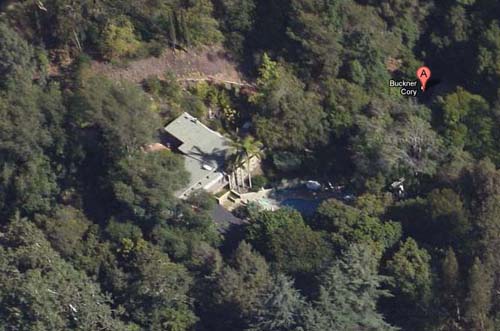
2013 -  MHA Site Office on Crestwood Hills at 990 Hanley Street in Brentwood, USA (Google Maps)
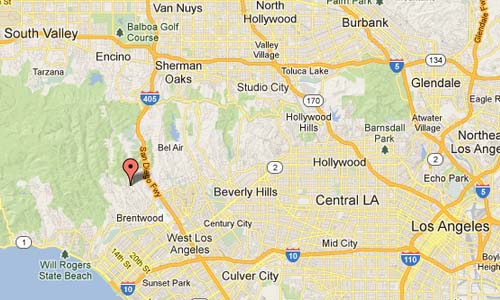
2013 – MHA Site Office on Crestwood Hills at 990 Hanley Street in Brentwood, USA (Google Maps)

Crestwood Hills Map

More information at en.wikipedia.org, www.westsidetoday.com, corybuckner.com and http://designapplause.com/

Historic Volvo Photography Locations Overview

William M Powell Bridge and Rickenbacker Causeway in Miami – USA 🇺🇸.

March 23rd, 2013

International Volvo Photo Locations Part 96
Historic Volvo Photography Locations Overview

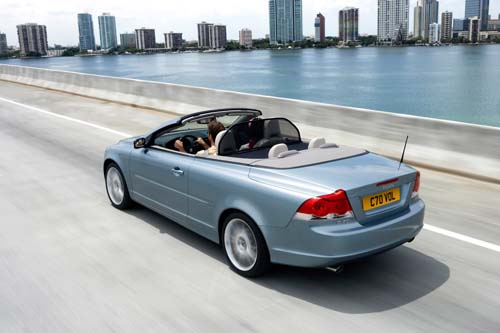
2006 - Volvo C70

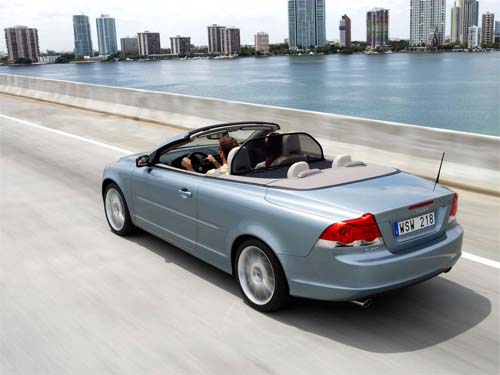
2006 – Volvo C70 on William M Powell Bridge and Rickenbacker Causeway in Miami in USA 🇺🇸.

2006 - Volvo C70

2006 – Volvo C70 on William M Powell Bridge and Rickenbacker Causeway in Miami in USA 🇺🇸.

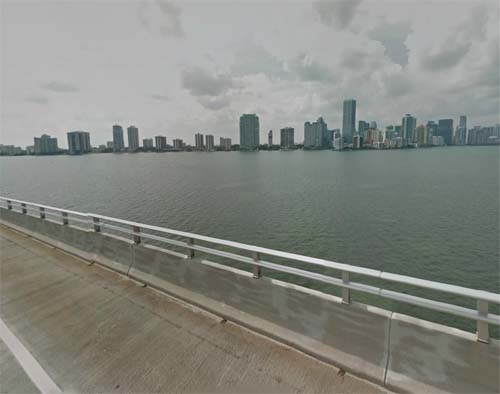
2013 - Rickenbacker Causeway in Miami FL USA (Google Streetview)

2013 – Rickenbacker Causeway in Miami FL USA (Google Streetview)

The Rickenbacker Causeway connects Miami, Florida, United States to the barrier islands of Virginia Key and Key Biscayne across Biscayne Bay.

The Causeway is a toll road, owned and operated by Miami-Dade County. Automobiles traveling southbound from Miami pay a toll of USD 1.50 as of March 2009; northbound traffic is not charged any toll.

Named after Eddie Rickenbacker, the American World War I flying ace and founder and president of Miami-based Eastern Air Lines, the causeway provides access to the Miami Seaquarium, the University of Miami Rosenstiel School of Marine and Atmospheric Science, MAST Academy, Virginia Key Park, and Miami Marine Stadium on Virginia Key, and to Crandon Park, the Village of Key Biscayne, and Bill Baggs Cape Florida State Park on the island of Key Biscayne.

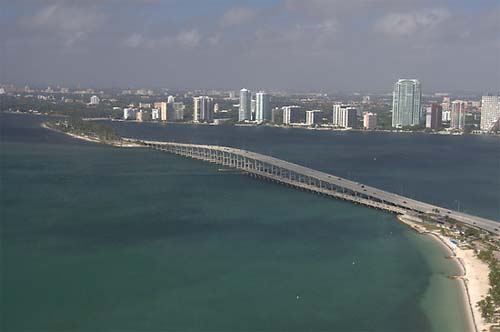
Miami Rickenbacker Causeway aerial view

In the late 1960s and 1970s the sites along the Rickenbacker Causeway continued to increase in popularity. After increasing in the mid 1960 because of the American television series Flipper, attendance to the Miami Seaquarium soared in 1968 when it started to display Hugo, its first killer whale (two years later, Lolita became their second. The two killer whales performed together until Hugo’s death in 1980). Shortly afterward, Planet Ocean, a themed tourist attraction, opened its doors. Newly integrated beaches were often crowded; the causeway near the drawbridge across the Intracoastal Waterway, and bridgeway near the mainland, became favorite fishing spots.

But popularity had a price: by 1980 it became evident that the concrete and steel structures supporting the roadway west of Virginia Key needed replacement. Five years later, the high-rise William Powell Bridge and new bridging nearest the toll plaza were built and opened at a cost of $27 million. With exception of the drawbridge (which was removed) the old bridging was left intact to serve as fishing piers.

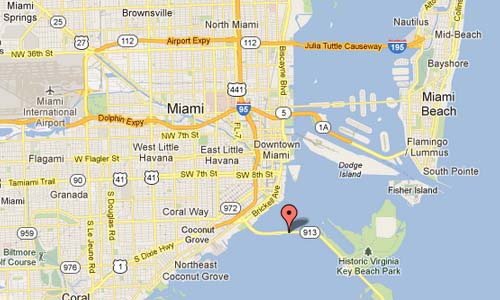
Miami Skyline Map

More information at en.wikipedia.org

Historic Volvo Photography Locations Overview

Chopin Plaza on Brickell Key Park in Miami – USA 🇺🇸

March 23rd, 2013

International Volvo Photo Locations Part 95
Historic Volvo Photography Locations Overview

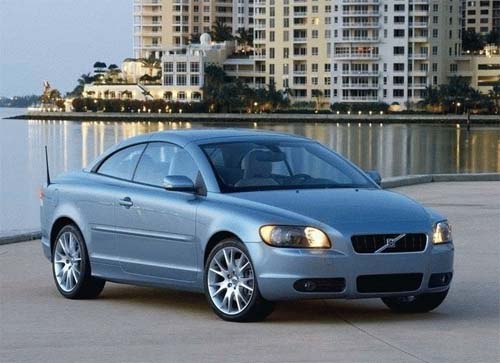
2006 - Volvo C70

2006 – Volvo C70 at Chopin Plaza on Brickell Key Park in Miami in USA 🇺🇸.

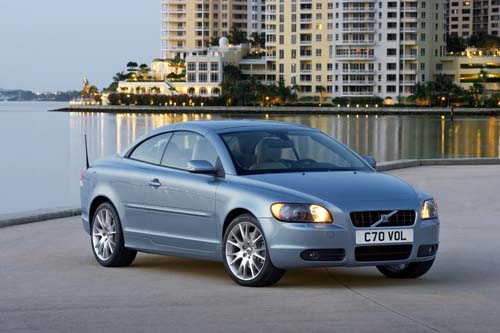
2006 - Volvo C70

2006 – Volvo C70 at Chopin Plaza on Brickell Key Park in Miami in USA 🇺🇸.

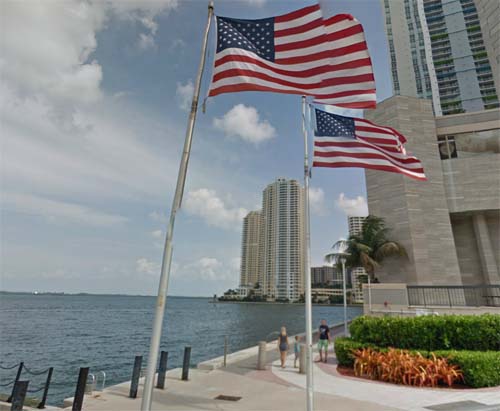
2013 - View from Chopin Plaza on Brickel Key Park in Miami, USA (Google Streetview)

2013 – View from Chopin Plaza on Brickell Key Park in Miami, USA (Google Streetview)

From Chopin PLaza in Miami, USA you have a great view on Brickell Key Park.

Brickell Key is a man-made island of the mainland Brickell neighborhood of Miami, Florida, United States. Also called Claughton Island, the neighborhood is just east of Downtown Miami and the Miami River.

The history of Brickell Key real estate can be traced to 1896, when Henry Flagler had a 9-foot (2.7 m) deep channel dug from the mouth of the Miami River. In the process, Mr. Flagler created an off-shore property composed of two small islands. In 1943, a real estate investor, Edward N. Claughton, Sr. acquired the Brickell Key islands and eventually purchased additional bay bottom land to combine them to a 44-acre (180,000 m2) triangle-shaped tract separated from Brickell and Brickell Avenue by only a few hundred feet of water.

In the late 1970s, Swire Properties purchased most of the island real estate property from the Claughton, and began to put into place a master plan that would ultimately transform it into one of the most distinctive island communities in the world.

Also developed by Swire Properties, the Asia Condo is the final project to be constructed on the island. It features 123 total units and 33 floors completed in 2008.

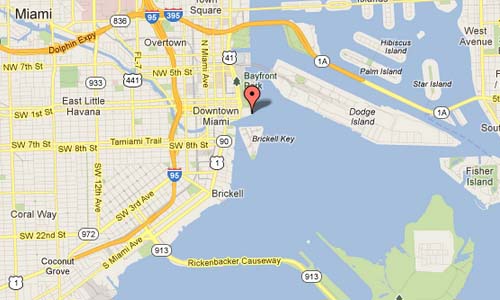
Brickell Key Park Miami Map

More information at www.brickellkeymiami.com.

Historic Volvo Photography Locations Overview